
HVAC coil cleaning process
Back to Blog HOME MAINTENANCE

Essential Coil Cleaning for HVAC Maintenance: A Facility Manager’s Guide

Apr 13, 2026 7 min read Alex Weber
Quick Read

This article covers:

  • How dirty coils reduce HVAC efficiency by 20–40%
  • Evaporator vs. condenser coils: what each does and how they fail
  • 5 warning signs your coils need cleaning now
  • Professional coil cleaning methods and what they cost
  • The maintenance schedule that prevents 80% of coil-related failures

Estimated read time: 5 minutes.

Your HVAC system has two sets of coils that make cooling and heating possible. The evaporator coil (indoor) absorbs heat from your space, and the condenser coil (outdoor) releases that heat outside. Together, they're the engine of your entire system — and when they get dirty, everything degrades.

Dirty coils are the most common — and most overlooked — cause of HVAC inefficiency. A layer of dust, dirt, or biological growth as thin as 1/100th of an inch reduces heat transfer by 5%. After a year without professional maintenance, that efficiency loss climbs to 20–40%, meaning your system works harder, runs longer, and costs significantly more to operate — all while delivering less comfort.

This guide explains exactly how coil fouling happens, how to recognize it, and what professional coil cleaning involves — so you can protect the most critical components of your HVAC system.
Warning Sign #01

Rising Energy Bills with No Usage Change

If your electricity bills have increased 15–30% over the past year with no change in usage patterns, dirty coils are the most likely culprit. Fouled coils force the compressor to run 30–50% longer cycles to achieve the same temperature, directly increasing energy consumption.

Evaporator coil fouling increases cooling energy by 20–40%
Condenser coil fouling increases compressor energy by 15–30%
Combined effect: total HVAC energy can increase 30–50%
A $200 coil cleaning can save $400–$800/year in energy
Compare current bills to same month previous year for baseline
Warning Sign #02

System Running Constantly Without Reaching Setpoint

When the thermostat is set to 72°F but the system runs nonstop and only achieves 76–78°F, it's struggling to transfer heat effectively. Dirty evaporator coils can't absorb enough heat from the air, and dirty condenser coils can't reject enough heat outside — leaving the system in a perpetual losing battle.

Healthy system: reaches setpoint within 15–20 minutes of cycling on
Fouled coils: system runs 45–60+ minutes per cycle
Temperature differential across coil drops from 18–22°F to 8–12°F
Extended run times accelerate compressor wear
This symptom worsens as outdoor temperatures rise above 90°F
Warning Sign #03

Ice Formation on Indoor Coil or Refrigerant Lines

Visible frost or ice on the evaporator coil, refrigerant lines, or even the outdoor unit during cooling mode is a critical warning sign. Restricted airflow from a dirty evaporator coil causes the coil temperature to drop below freezing, creating an ice buildup that eventually blocks airflow entirely.

Ice on the evaporator coil = immediate shutdown needed
Turn system off and let ice melt completely (2–4 hours)
Do NOT chip or scrape ice — you'll damage the coil fins
Check filter first — a clogged filter has the same effect
If filter is clean and icing recurs, the coil needs professional cleaning
Warning Sign #04

Musty or Stale Odors from Vents

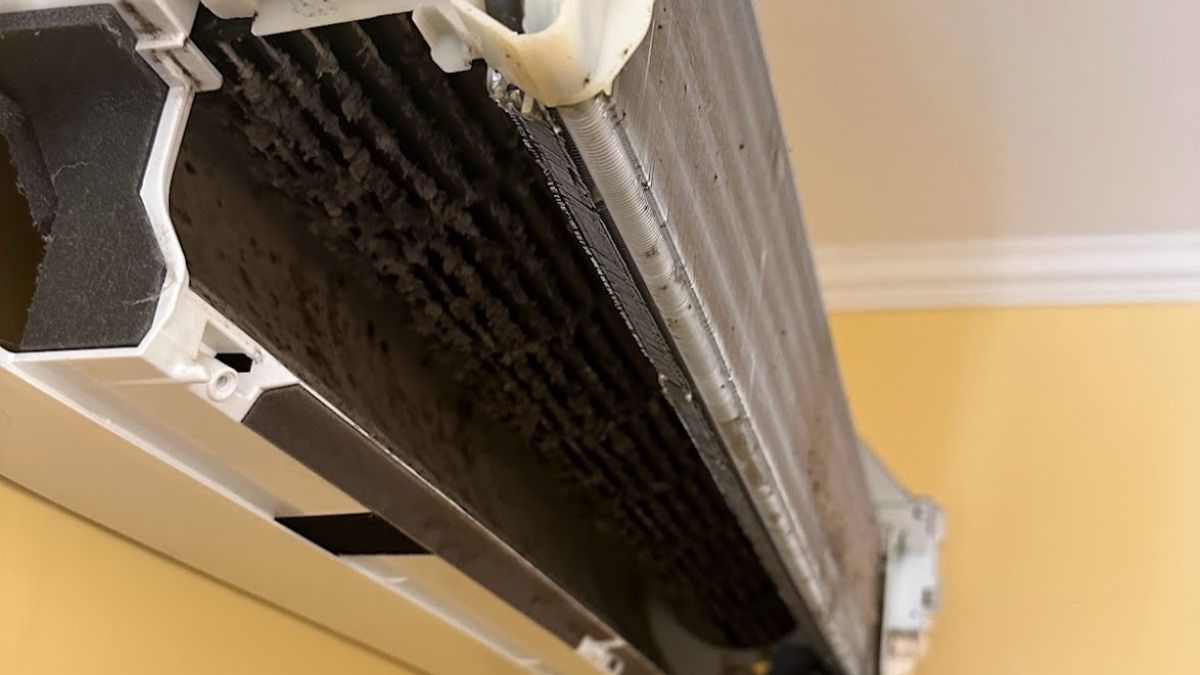
Evaporator coils are constantly wet during cooling cycles — they condense moisture from the air. A dirty coil with organic buildup becomes a breeding ground for mold, mildew, and bacteria. The result: every time the system runs, it circulates contaminated air throughout your space.

Biological growth on coils requires antimicrobial treatment, not just rinsing
Mold on coils can trigger allergies, asthma, and respiratory issues
Condensate drain pans often harbor the same growth
UV-C lights near the coil prevent biological growth between cleanings
Professional cleaning includes biocide application to eliminate growth
Warning Sign #05

Visible Dirt Buildup on Condenser Unit

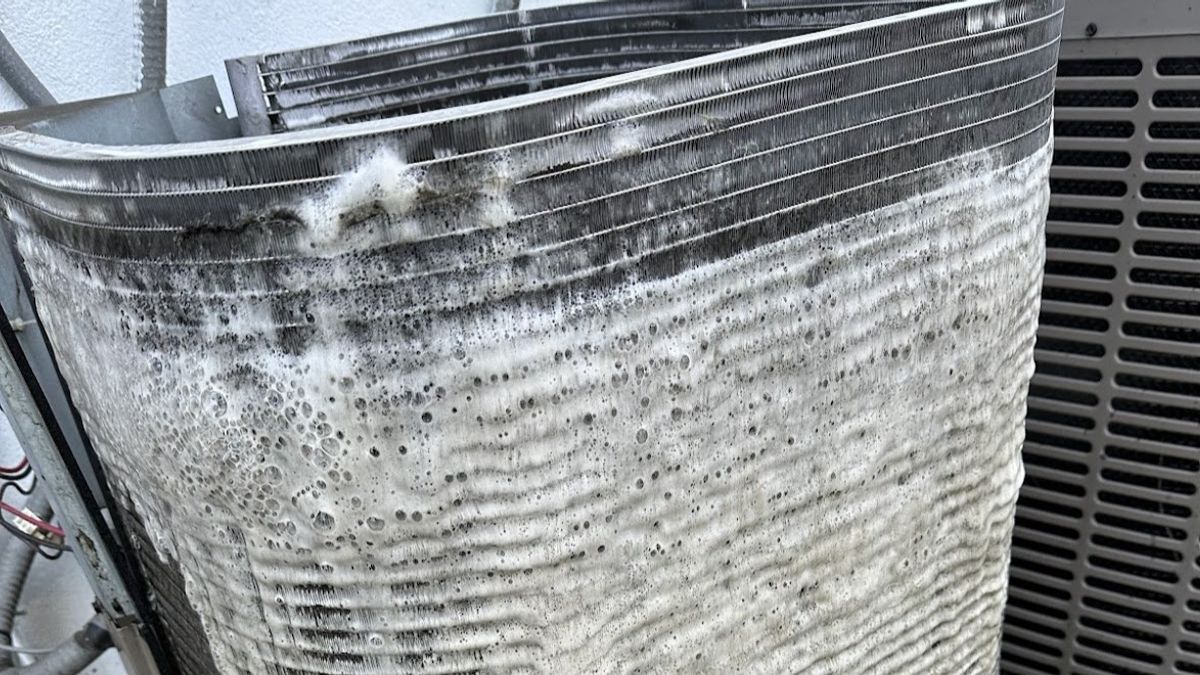
Look at your outdoor condenser unit. If the aluminum fins are coated with dirt, pollen, grass clippings, cottonwood seeds, or debris, airflow is restricted and heat rejection is compromised. NYC's urban environment — construction dust, vehicle exhaust, and restaurant grease — accelerates condenser fouling significantly.

Condenser coils should look clean and silver/aluminum colored
Brown or gray coating indicates significant fouling
Bent or matted fins reduce airflow even after cleaning
Maintain 2-foot clearance around the condenser unit
Commercial condensers near restaurants need monthly exterior rinses

Evaporator vs. Condenser Coils: Understanding the Difference

Both coils perform heat transfer, but in opposite directions — and they fail differently:

The evaporator coil (indoor) sits inside your air handler or furnace. Cold refrigerant flows through the coil while the blower pushes warm indoor air across it. The coil absorbs heat from the air, cooling it before it returns to your space. As a byproduct, moisture condenses on the cold coil surface and drains away through the condensate drain line. This constant moisture makes the evaporator coil a magnet for dust, biological growth, and debris that sticks to the wet surface.

The condenser coil (outdoor) sits in the outdoor unit, exposed to weather and environmental contaminants. Hot refrigerant flows through the coil while the condenser fan pulls outdoor air across it, releasing the heat absorbed indoors. Because it's outdoors, the condenser coil collects dirt, pollen, leaves, grass clippings, and in NYC, construction dust and vehicle exhaust residue.

The critical insight: both coils must be clean for the system to work efficiently. Cleaning one while ignoring the other is like washing only one side of a window — the system can only transfer heat as well as its dirtiest coil allows.

The Real Cost of Dirty Coils

A typical residential AC system costs $1,200–$2,400/year in electricity. With fouled coils, that jumps to $1,560–$3,360/year — an extra $360–$960 per year in wasted energy. Professional coil cleaning costs $150–$400. The payback period? Under 6 months. Over a 15-year system lifespan, clean coils save $5,400–$14,400 in energy alone — not counting avoided repairs and extended equipment life.

COIL CLEANING & REPAIR COSTS

What Professional Coil Service Costs

Basic Condenser Coil Rinse$100–$200
Full Evaporator + Condenser Cleaning$250–$450
Deep Chemical Clean (Heavy Fouling)$350–$600
Evaporator Coil Replacement$800–$2,500

* NYC metro area pricing. Costs vary by system size, accessibility, and condition. Commercial systems are at the higher end of each range.

Regular Cleaning vs. Neglected Coils

Annual Coil Maintenance (Recommended)
System efficiency maintained at 95–100% of rated capacity
Energy costs stay predictable and within normal range
Compressor runs shorter cycles, extending its 15–20 year lifespan
Indoor air quality maintained — no mold or bacteria on coils
Condensate drains freely, preventing water damage
Small issues caught early during cleaning visits
Skipping Coil Maintenance (Not Recommended)
Efficiency drops 20–40% within 1–2 years
Energy bills increase $360–$960/year in wasted electricity
Compressor overheats, fails prematurely at 8–12 years
Mold and bacteria circulate through ductwork into living spaces
Clogged condensate causes water leaks and ceiling damage
Minor fouling becomes corrosion requiring $800–$2,500 coil replacement

Professional Coil Cleaning: What Actually Happens

Professional coil cleaning isn't just hosing down the outdoor unit. A thorough service includes multiple steps for each coil:

  • Condenser coil (outdoor): Power off the unit. Remove debris from around and inside the cabinet. Apply commercial-grade coil cleaner (alkaline or acidic depending on fouling type). Allow dwell time for the cleaner to dissolve deposits. Rinse with controlled-pressure water from inside out (never outside in — that pushes debris deeper into the fins). Straighten any bent fins with a fin comb. Inspect for corrosion or refrigerant leaks.
  • Evaporator coil (indoor): Access the coil (may require removing access panels). Apply no-rinse evaporator coil cleaner or foam cleaner. Treat with antimicrobial biocide to eliminate mold and bacteria. Clean the condensate drain pan. Flush the condensate drain line. Check the coil for corrosion or refrigerant leaks. Verify proper airflow and air quality after cleaning.

The entire process takes 1–2 hours for residential systems and 2–4 hours for commercial units. It should be performed annually as part of your spring AC tune-up — ideally before the cooling season starts.

Never use a pressure washer on HVAC coils. The high pressure bends and damages the delicate aluminum fins, making the problem worse. Professional technicians use controlled, low-pressure water with coil-specific cleaning solutions.
What You Can Do vs. What Requires a Pro

DIY-safe: Gently rinsing the outdoor condenser coil with a garden hose (from inside out), removing debris from around the unit, and changing your air filter monthly. NOT DIY-safe: Accessing the evaporator coil (requires opening the air handler), applying chemical cleaners (wrong products damage coils), straightening bent fins (requires a specific fin comb), and checking refrigerant charge (requires EPA 608 certification). Attempting evaporator coil cleaning without training risks damaging the coil, voiding your warranty, and creating refrigerant leaks.

COIL CLEANING

Frequently Asked Questions

Find answers to common questions about our HVAC, plumbing, and refrigeration services.

Residential systems: annually, ideally in spring before cooling season. Commercial systems: bi-annually (spring and fall) for standard environments, quarterly for restaurants, manufacturing, or high-dust locations. Condenser coils in urban environments like NYC may need a mid-season rinse during peak summer due to higher airborne particulate levels.

Yes — dirty coils are one of the leading causes of premature compressor failure. When the condenser coil can't reject heat efficiently, the compressor runs at higher pressures and temperatures. This overheating breaks down compressor oil, damages internal components, and can lead to complete compressor failure — a repair that costs $1,500–$3,000 for residential systems and $3,000–$8,000 for commercial units.

Most professional HVAC maintenance plans include condenser coil cleaning as a standard service. However, evaporator coil cleaning is often listed as an 'as needed' service with an additional charge, since it requires more time and access. Ask your provider specifically: 'Does your maintenance plan include both evaporator and condenser coil cleaning?' If not, add it — it's the single most impactful maintenance task for system efficiency.

Coil cleaning removes surface contamination (dirt, biological growth, debris) and restores heat transfer efficiency. Coil replacement is necessary when the coil has structural damage: severe corrosion, refrigerant leaks, or crushed fins that can't be repaired. Cleaning costs $150–$600; replacement costs $800–$2,500. Regular cleaning prevents the corrosion and damage that eventually requires replacement.

You can safely rinse the outdoor condenser coil with a garden hose (low pressure, from inside out) and keep the area around it clear of debris. However, evaporator coil cleaning should be left to professionals. It requires opening the air handler, using coil-specific cleaners, applying antimicrobial treatment, and verifying system operation afterward. Using the wrong cleaner or technique can damage the coil's protective coating and void your warranty.

Limited Availability

Clean Coils, Lower Bills — Schedule Your Tune-Up

Don't let dirty coils silently drain your energy budget. Our technicians clean both evaporator and condenser coils during every maintenance visit — restoring your system's efficiency and preventing the costly breakdowns that come from neglected coils.

Alex Weber

Marketing and Sales dept