

The Bronx HVAC reality: scale, institutions, and one waterfront island
The Bronx is the only NYC borough on the mainland — and it has the largest single concentration of big buildings of any borough. Co-op City has more housing units than most US cities. Hunts Point feeds half the metro area. And City Island is a fishing village reachable by one bridge. Each demands a different HVAC approach. Here is how we work the building types you will actually find here.
1. Large multi-family rentals (Concourse, Pelham Parkway, Bronx Park East, Soundview)
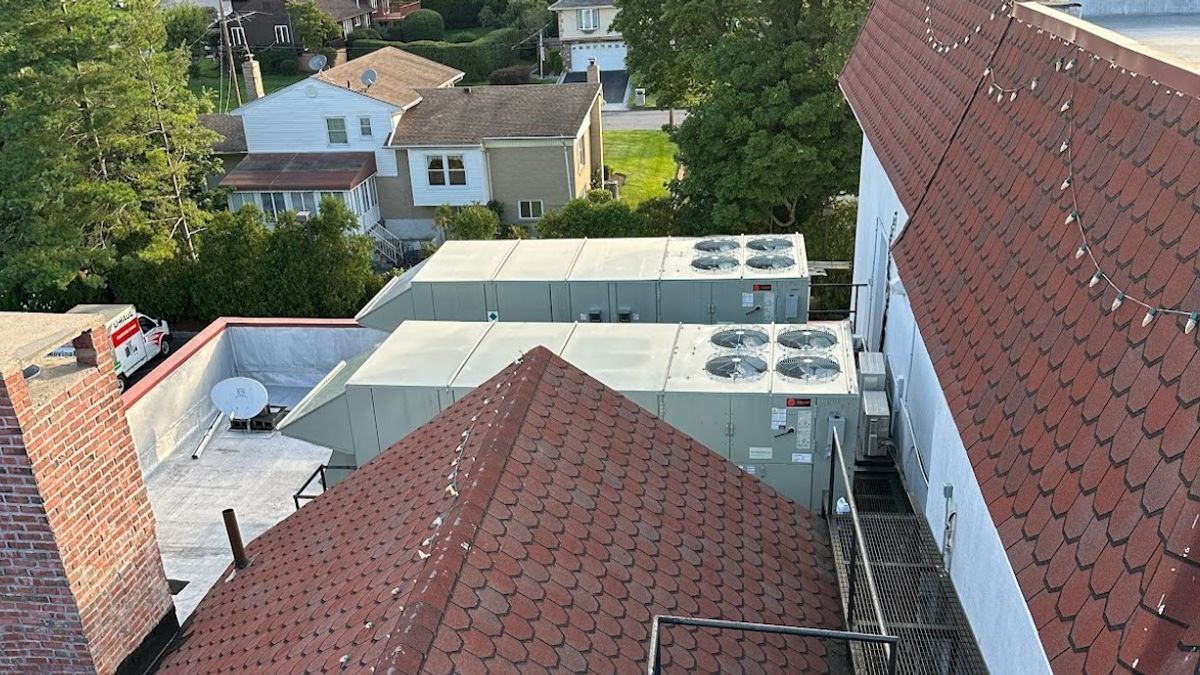
These are the 50-300 unit rental buildings that make up the bulk of Bronx housing. Most are post-war (1950s-1970s) with central steam heat owned by the building, individual cooling via through-wall PTAC sleeves, and shared roof-mounted condensers serving common areas. Management companies typically run 5-50 buildings each, which is why preventative maintenance contracts dominate this segment — emergencies on this scale get expensive fast. We work both as the contracted maintenance vendor and as the on-call repair crew when the contracted vendor is overloaded.
2. Co-op City and Mitchell-Lama affordable co-ops (Co-op City, Esplanade Gardens, Twin Parks, Castle Hill Houses)
Co-op City is North America's largest cooperative — 35 buildings, 15,000+ units, 320 acres in the northeast Bronx. Mitchell-Lama and HDFC co-ops elsewhere in the borough operate similarly: regulated rents, owner-occupied with restrictions, and decisions made by smaller, more practical boards than Manhattan's prestige co-ops. Approval timelines run 2-3 weeks, paperwork requirements are real but reasonable, and we have a working relationship with most of the building engineering offices.
3. Single-family detached homes (Riverdale, Fieldston, Country Club, Throggs Neck, Edgewater Park)
The Bronx's single-family enclaves are some of NYC's most overlooked HVAC opportunities. Riverdale and Fieldston have older brick and stone homes (often with original hot-water radiators or aging gas furnaces) where heat pump conversions earn back rebate money quickly. Country Club, Throggs Neck, and Edgewater Park are waterfront single-family neighborhoods with proximity to Long Island Sound — they need salt-rated equipment selection but otherwise work like Queens single-family installs.
4. Pre-war attached and historic districts (Mott Haven Historic, Belmont/Arthur Avenue, Fieldston Historic)
The Bronx has its own landmark and character districts. Mott Haven Historic District covers brick row houses near the Harlem River. Fieldston is privately owned (governed by the Fieldston Property Owners' Association) with covenants on exterior changes. Belmont's Arthur Avenue corridor mixes residential brick attached homes with the Bronx's most authentic Little Italy. We design installs that respect district rules — rear-yard or rooftop condensers, lineset routing through service yards, and coordination with the local design review board.
5. Post-war walk-ups and pre-war tenements (Belmont, Fordham, University Heights, Mount Hope)
Walk-up apartment buildings (4-6 stories, no elevator) that lack ductwork and were never designed for central air. The realistic options are ductless mini-splits per unit (best for owners) or PTAC sleeve replacements (best for landlords doing per-unit upgrades). These buildings rarely have HOA-style review — the building owner decides — but tenant-paid utility configurations need to stay clean for HPD compliance.
6. City Island — the Bronx fishing village
City Island is a 1.5-mile-long island in Long Island Sound, connected to the Bronx mainland by one bridge. Salt air corrodes standard condenser coils in 3-5 years. Streets are narrow, freight elevator infrastructure does not exist, and equipment delivery sometimes happens by trailer at the bridge. We use coastal-rated equipment (corrosion-protected coils, marine-grade fasteners, sealed electrical enclosures) and we plan installs around tide schedules and the island's weekday-only commercial truck rules. This is the only NYC neighborhood where these constraints all apply at once.
7. Commercial and institutional (Hunts Point, Arthur Avenue, Montefiore-area, Fordham University)
Hunts Point Food Distribution Center is the largest food market in the world by volume — produce, fish, meat — and it runs on industrial-scale refrigeration that cannot fail. Arthur Avenue restaurants need traditional Italian-kitchen exhaust hoods (high-temperature pizza ovens, charcoal grills, deep-fryers) sized differently than Astoria's Greek tavernas. Montefiore Medical Center's surrounding healthcare corridor demands hospital-grade IAQ and redundancy. Fordham University's Rose Hill campus requires institutional facilities-management coordination. We work all four segments and we know each has its own rhythm.