

Queens HVAC: more housing variety than any other NYC borough
Queens packs more housing types into more square miles than any other NYC borough. A 1920s Tudor in Forest Hills Gardens has nothing in common with a Long Island City glass tower, and a Rockaway beach house has different rules than a Whitestone single-family. The right HVAC depends entirely on which Queens you live in. Here is how we approach each one — and what to ask for in your specific home.
1. Single-family detached homes (Bayside, Whitestone, Douglaston, Little Neck)
Most are 2-3 stories, brick or stucco, built 1930s-1970s, with basement-mounted boilers (gas or oil) and either no central AC or aging window units. The biggest Queens opportunity right now: heat pump conversions that replace BOTH the heating and cooling systems with one unit. Existing ductwork often doesn't exist or runs only in the basement, so we install ducted attic air handlers or zoned ductless heads. Side-yard or rear-yard condenser placement is straightforward — none of the Manhattan or Brooklyn co-op politics.
2. Two- and three-family houses (Astoria, Jackson Heights, Maspeth, Sunnyside)
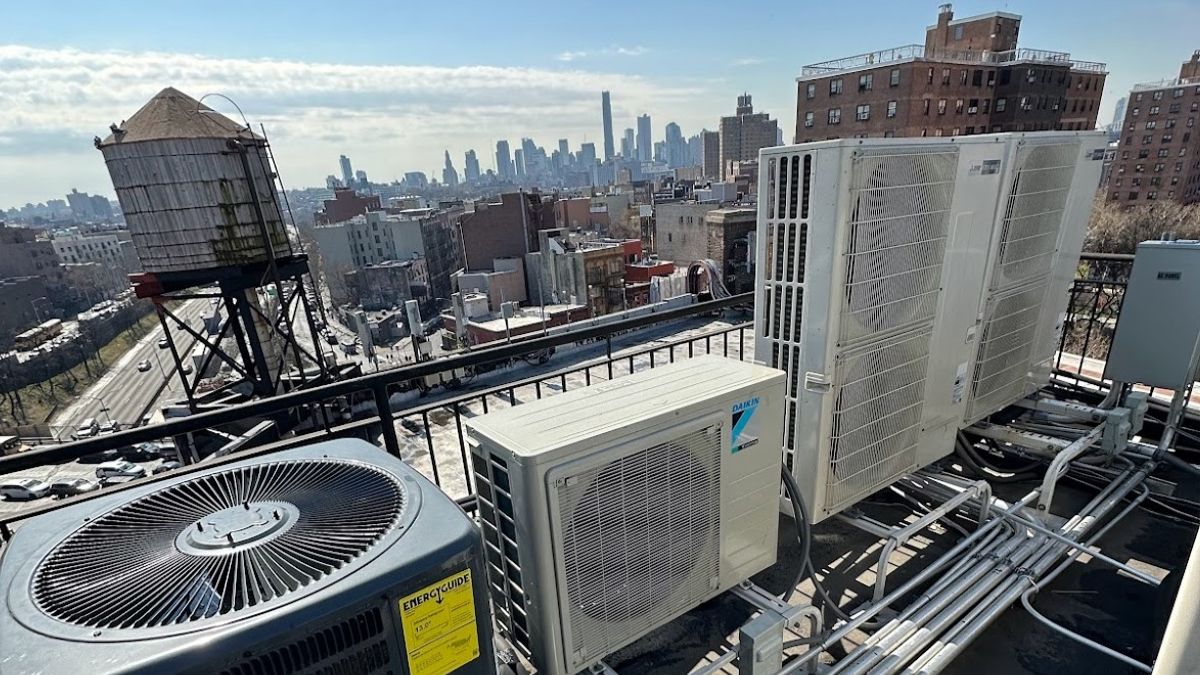
Queens has more two- and three-family homes than any other borough. Each unit usually needs its own system — owner-occupant on one floor, tenants on others, separately metered. We design per-unit ductless or ducted systems, balance condenser placement on rear walls or rooftops, and configure thermostats so tenant-paid utilities stay tenant-controlled. Common gotcha: owners installing one big system and trying to cross-charge tenants — we steer clear of those configurations because they fail HPD scrutiny.
3. Garden apartment co-ops and condo complexes (Lefrak City, Parker Towers, Forest Hills co-ops, Rego Park)
These are smaller-scale versions of Manhattan's pre-war co-ops — central steam heat the building owns, individual cooling each owner installs. Sleeve PTACs are common; ductless mini-splits where boards permit interior wall units. Approval timelines are shorter than Manhattan (2-3 weeks typical) but the building still wants stamped drawings and a COI on file before install day.
4. Pre-war Tudor and brick attached (Forest Hills Gardens, Sunnyside Gardens, Jackson Heights Historic)
Queens has its own landmark and HOA-restricted neighborhoods — Forest Hills Gardens (private streets, restrictive covenants), Sunnyside Gardens (LPC-designated), and Jackson Heights Historic District. Exterior changes need approval from the local board or LPC. We design installs around those rules: rear-facing condensers, rooftop placement screened by parapets, and lineset routing through service yards rather than street-visible facades.
5. Long Island City high-rises (Hunters Point, Court Square, Queensbridge waterfront)
Built 2010s-present. Most are central VRF or chilled-water systems with in-unit fan coils — same equipment as new Manhattan high-rises but cheaper rent. Service work is at the unit level: thermostat upgrades, fan coil swaps, valve repairs, and warranty claims through the original manufacturer. Building engineers run the central plant; tenants don't modify it.
6. Coastal homes (Rockaway, Howard Beach, Broad Channel, Belle Harbor)
Salt air corrodes standard condenser coils in 3-5 years. Post-Sandy FEMA flood elevation requires mechanical equipment above the BFE (Base Flood Elevation) — usually rooftop or elevated platform, not ground level. We use coastal-rated equipment (corrosion-protected coils, marine-grade fasteners), specify equipment that survives saltwater immersion certifications, and we work with elevation contractors when full-house lift work is in the project. This is uniquely Queens — you don't need this on the Upper East Side.
7. Commercial kitchens and food-service spaces (Astoria, Flushing, Jackson Heights)
Queens has the most diverse food scene in NYC. Greek tavernas in Astoria, Sichuan kitchens in Flushing, Indian thali halls in Jackson Heights — each cuisine has different hood, makeup-air, and refrigeration needs. High-flame Greek and Korean kitchens need oversized hoods and FDNY-compliant exhaust. Tandoor and pizza ovens need different hood profiles. We design commercial kitchens around the actual menu, not a generic specification — and we coordinate refrigeration sizing with prep volume, not square footage.