
Payment plan request

Get your payment plan

Check what you picked and tell us where to reach you. We confirm the price and send your financing options together with your estimate.We confirm the price and send your financing options together with your estimate.

Plan length ≈ $317/mo · 0% APR*≈ $317/mo · 0% APR*

What do you need?

We come out, check your space and give you a written price. Estimates for new systems and replacements are free.We come out, check your space and give you a written price. Estimates for new systems are free.

Where can we reach you?

No obligation. Checking your financing options won’t affect your credit score.No obligation · won’t affect your credit

*All financing is subject to credit approval. Your terms may vary. Payment options through Wisetack are provided by our lending partners. For example, a $5,500 purchase could cost $253.54 per month for 24 months, based on a 9.9% APR, or $1,833.33 per month for 3 months, based on a 0% APR. Offers range from 0 to 35.9% APR based on amount requested and creditworthiness. Not all merchants and lending partners participate in 0% interest programs. Terms range from 3 - 120 months and may vary based on merchant, lending partner, or transaction size. State interest rate caps may apply. No prepaid finance charges or participation fees. See additional terms at wisetack.com/faqs.

ART HVAC offers financing on jobs from $500 to $25,000. Payments shown are estimates for illustration, not an offer of credit.

Brooklyn HVAC Contractor: Heating and Cooling by the Year Your House Was Built

Tell an HVAC contractor the year a Brooklyn building went up, and a good one can guess what is in the cellar. An apartment house from 1931 is nearly always on steam. So is one from 1962, whatever its brick says. A condo from 2015 is as likely as not to have no boiler at all, and the machine in its closet is often yours to fix. We are an HVAC company with an office on Stuart Street: repair, maintenance, installation, commercial systems and refrigeration. Below: what each decade runs on, what every service covers and costs, and our own jobs.

Two beige two-fan outdoor units on steel rails on a flat roof, the nearer one with its side panel off and its board and wiring showing, two gray disconnects on a post between them, a white screen wall behind
Two outdoor units on roof rails, one with its panel off.
  • $200 service call, credited in full toward the repair
  • Installation estimates are free
  • Office at 1865 Stuart Street

The Year on the Building Tells You What Heats It

By the Census Bureau’s count 47% of Brooklyn’s homes were built before 1940, the highest share of the five boroughs. What heats them follows the calendar more closely than the architecture, and the city has the proof on file: the energy audits of its large apartment houses. The ground under this street is made of 1,711 of them. Pick your decade.

How large apartment houses here are heated, by the decade they were built; the percentage is steam. On the buildings, blue marks where the heat shows: a chimney, a grille, a roof unit.

  • Steam
  • Hot water
  • Warm air: furnace or packaged unit
  • Heat pump or electric
  • Not clear

Before 1920

30% of residential properties, 20% of homes

About three in four of the residential properties in Brooklyn Heights and in western Bed-Stuy (11216), seven in ten in Park Slope and Boerum Hill.

What usually heats it

A row house usually has a boiler of its own: steam, hot water, or a combi on the wall. In an apartment house this old the last gut renovation decides. Of the 72 audited, 34 are on hot water and 26 on steam, and city records show 30 of those 34 altered in 1980 or later.

What we get called for

Combi boilers low on pressure or full of scale, an indirect tank with a clogged coil, a steam vent, a gas valve, an ignition module.

Before you spend money

Date the boiler, not the house. The newest pipe in the wall decides what can come after it. Where an outdoor unit can go on a row house
1920s to 1940s

49% of residential properties, 40% of homes

Eight in ten residential properties around Sheepshead Bay and in Bensonhurst, three in four in Gravesend and Dyker Heights.

What usually heats it

Steam, in 844 of the 916 apartment houses audited. Nine in ten of those are one-pipe: steam goes up and water comes back down the same pipe. The brick one- and two-family houses of the time usually have a boiler in the cellar or, where somebody added ducts, a furnace.

What we get called for

Steam boilers and everything bolted to them, from thermocouples to control boards; circulator pumps; water heaters; central air and furnaces toward the south shore.

Before you spend money

The pipes outlive the boilers. In the audits from 2019 to 2024, more than half of the steam boilers in buildings from the 1920s and 1930s had been put in by 1984. A new one is matched to the radiators on those pipes. Boiler replacement

1950s and 1960s

10% of residential properties, 15% of homes

Six in ten residential properties in Canarsie, three in ten in Marine Park and Mill Basin, half of the homes on Coney Island.

What usually heats it

Still steam, in 419 of the 444 audited. The brick turned plain and the windows wide, but the cellar didn’t change: a building from 1962 is as likely to be on steam as one from 1928. About one in six of these is two-pipe, usually with a steam trap at each radiator instead of an air vent.

What we get called for

Through-the-wall air conditioners, central systems in houses, and the walk-ins and cold rooms of one-story shops and warehouses.

Before you spend money

One end of the building bakes and the other is cold? Have the traps, vents and valves tested before anyone prices a boiler. A new boiler feeds the same failed traps. A checklist for the building’s boiler

1970s to 1990s

5% of residential properties, 6% of homes

Seven in ten homes in the Starrett City ZIP code, four in ten residential properties on Coney Island, one in four in Brownsville.

What usually heats it

The seam runs here. Steam is in 33 of the 45 audited buildings from the 1970s and in only 10 of the 50 from the two decades after. Past it come hot-water baseboards and, in attached houses, a furnace or a small boiler.

What we get called for

Boiler tune-ups and flushes, furnaces, an inducer motor.

Before you spend money

Two neighbors can have two systems, so look before you guess. How to tell steam, hot water and ducts apart

The 2000s

4% of residential properties, 5% of homes

One in six residential properties between Williamsburg and Bushwick (11206), one in eight in East New York.

What usually heats it

Hot water in 75 of the 134 audited, and often a machine inside the apartment: about a quarter list PTACs, and in one in six the heat comes out as warm air.

What we get called for

VRF control boards, rooftop units, low-water cutoffs, disconnects and thermostats.

Before you spend money

Read the date on the outdoor unit. Cooling equipment made before 2010 may hold R-22, which is no longer made or imported, and that settles a repair-or-replace question faster than a test does. Repair costs, and when to stop repairing

2010 and later

2.5% of residential properties, 13% of homes

Nearly four in ten homes in the ZIP codes of Boerum Hill and Brooklyn Heights, which take in Downtown; more than one in three in Greenpoint.

What usually heats it

Electricity heats half of these homes; in homes from before 1940 it heats 9%. Heat pumps, VRF, through-wall heat pumps, sometimes plain baseboard. A new building under seven stories whose plans were filed after December 31, 2023 can’t heat with gas or oil at all, with a few exceptions (Local Law 154).

What we get called for

LG and Daikin VRF: control and communication boards, condensate pumps, drain lines, a refrigerant leak. And gas furnaces, in the condos that have them.

Before you spend money

Find out what is yours. The indoor unit usually is; the one on the roof may serve only you or the whole line, and the offering plan says which. VRF and VRV

Audits: energy audits published under Local Law 87, 2012–2024, joined to the city’s tax lots; mostly residential lots with ten or more homes, 45 to 412 per bar. Properties and homes: PLUTO 26v3, by year built; neighborhoods are ZIP codes. Electric heat: American Community Survey, 2020–2024. What we get called for: our own job records, matched to the year the city has for the building. A period is a likelihood, not a diagnosis of your building.

HVAC Services in Brooklyn: Repair, Replace, Install, Keep Cold

Each line says what the work covers; the dollar ranges are the ones on our price list.

Repair and maintenance

  • HVAC repair

    Boilers, furnaces, central air, heat pumps, rooftop units. The page goes symptom by symptom and says what to do first about gas or a CO alarm.

    $200 service call, credited in full toward the repair

  • HVAC maintenance

    What a tune‑up covers on each kind of system, and when to book it. Every maintenance visit ends with a written condition report.

    AC tune‑up $250–$450

Heating: installation and replacement

  • Boilers

    Steam, with the header and the piping around it rebuilt; hot water, with its pumps and tank; a combi on the wall.

    New $5,200–$15,000

  • Furnaces

    A new one on the ducts you have, with the exhaust and the drain worked out first.

    New $5,000–$9,000

  • Whole-house heat pumps

    What takes over from steam, hot water or a furnace, what stays, and what each costs to run.

    New $7,200–$18,000

  • Water heaters

    Gas tanks, tankless units, and indirect tanks heated by the boiler.

    On the price list

Cooling, ducts and air

  • Ductless mini-splits

    Where the outdoor unit may stand, Landmarks and flood rules, and the arithmetic for a two‑family house.

    One room $2,850–$7,500 Two to five rooms $5,900–$18,000

  • Central air

    The outdoor unit and the coil that matches it, with more outlets or a bigger return where the ducts fall short.

    New $5,000–$12,000

  • Ductwork and zoning

    Runs taken down, repaired and rehung; returns, filter boxes, dampers and zone panels.

    Quoted on site

  • Duct cleaning and indoor air quality

    A look inside before anyone cleans. With radiators there are no ducts, and better air means exhaust, outdoor air and a filter.

    Quoted on site

Commercial HVAC

  • Rooftop units and commercial heat pumps

    Inducers, belts, heat exchangers, controls; make‑up air and kitchen exhaust; a new unit on the old curb or a new one.

    Quoted on site

  • VRF and VRV

    New systems for condos, offices and restaurants; boards, addresses, drains and leaks on the ones already up.

    3 to 8 zones $15,000–$45,000

Refrigeration

Boiler prices cover houses and buildings of up to five units; a larger boiler is quoted per project.

HVAC Installation and Replacement in Brooklyn: What Stays in the Walls

A building wears out several machines and one set of pipes. So read a replacement quote for what it keeps. Houses of one to four families have no audit on file, but a state survey shows the picture: NYSERDA reached 67 such homes here in 2018, and 45 of them heated with a boiler and 15 with a furnace. Not sure which you have? Eight systems side by side.

What stays, and what goes out with the machine
Going outStaysChanges with it
Steam boilerRisers and radiatorsHeader, equalizer, Hartford loop; often a chimney liner
Hot‑water boilerPipes and radiatorsPumps, expansion tank, controls
FurnaceDucts, once checkedExhaust, condensate drain, the coil if the cooling goes too
Central airDucts and the spot outsideOutdoor unit and indoor coil, as a pair made for R‑32 or R‑454B
PTAC or sleeve unitThe sleeveThe chassis, in that sleeve’s size
Rooftop unitThe curbA crane, and a curb adapter if the shape differs
Walk‑in condensing unitThe boxA line flush, the drier; the evaporator if it is worn
The usual split. What your system keeps is checked on site.

Furnace installation, where there are ducts to put it on

A furnace here often lives wherever someone found room for it. In Gravesend we put a 100,000 BTU gas furnace above a ceiling, with its 4‑ton condenser up on the roof. In a Kensington condo the furnace, its coil and the outdoor unit were replaced together, with the ducts and refrigerant lines inspected for reuse. The quote should say where the exhaust and the drain go, and how anyone reaches the filter.

Ductwork installation and repair, in houses built for pipes

When ducts come after the house, the trouble shows at the return: too small, too far, or the crack under a closet door. So we look at what the blower can move before adding outlets. Near Manhattan Beach a replacement came with three more supply grilles and another return, with a filter box. In Gravesend ducts were taken down, repaired and given new grilles with dampers. With no ducts at all, price ductless beside new ones before any plaster is cut. Which fuel costs less to run is a separate question, with numbers in our heating bill guide.

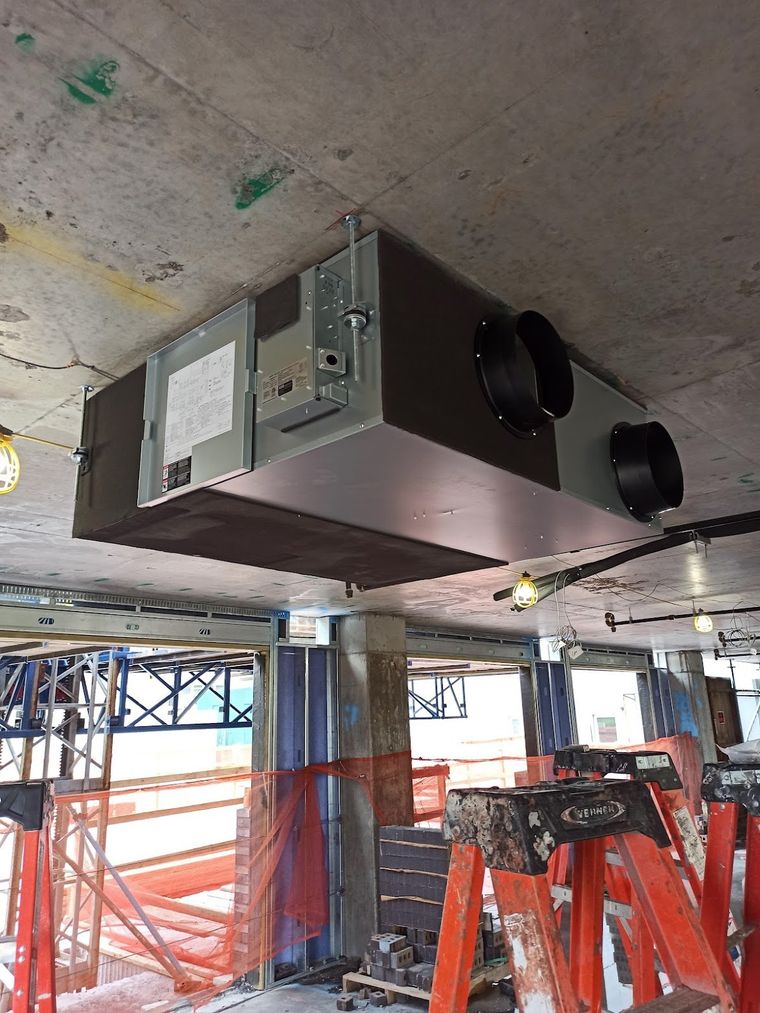
Gray and black ducted unit with two round black collars hung on threaded rods under a bare concrete slab, orange ladders and open window bays behind it
A ducted unit under a bare slab, waiting for its ducts.

Commercial HVAC in Brooklyn: Stores, Lofts, Offices, Warehouses

In a commercial building the roof says more than the year. Of the 106 warehouses in the same audits, 50 heat with furnaces or gas rooftop units, 16 are still on steam and 12 run on heat pumps. The work follows the roof too: inducers and heat exchangers in winter, coils and belts in summer, a crane when a unit is done.

A store with homes upstairs

City tax records list more than 18,000 properties in the borough with homes over a store or an office, and 95% of them were built before 1950. Their equipment has neighbors on the other side of the ceiling. The kitchen exhaust, the make‑up air and the condensing unit all have to end up somewhere that isn’t a bedroom window, and that is worth settling before the lease on the space is.

A loft has two birthdays

The wall may say 1910 and the heat 2004. Of the 22 condominiums audited in buildings from before 1920, two are still on steam. So ask for the date of the conversion and use that one on the street above. Then ask who owns the units on the roof, and who may send someone up there.

What a landlord or managing agent needs

We send a certificate of insurance naming the building when it asks for one, we handle the DOB filing where the job needs one, and every maintenance visit ends with a written condition report you can forward.

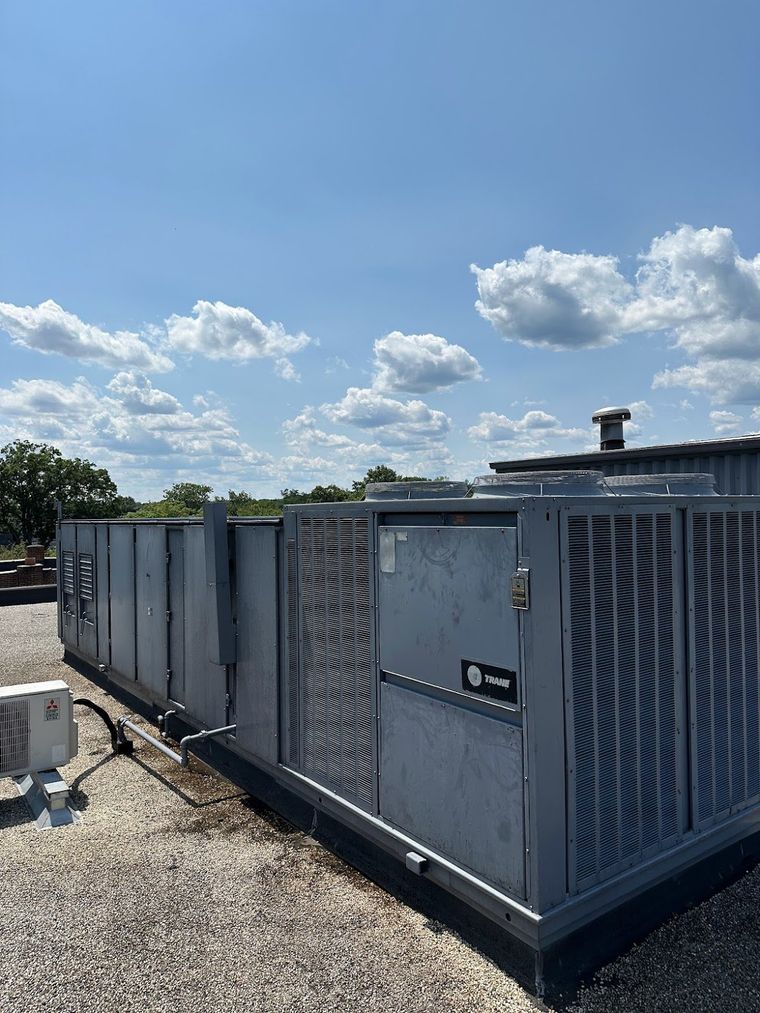
Long gray Trane packaged unit on a curb on a gravel roof, condenser fans on top, a small Mitsubishi outdoor unit at the left and trees behind the roof edge
A packaged unit on a gravel roof, a small split unit beside it.

Walk-Ins, Freezers, Ice Machines: The Sign and the Repair

Cold doesn’t follow the year. It follows the kitchen, and some of the coldest rooms we work on are inside the oldest buildings. These are repairs we have done here, each beside the way that kind of fault tends to look from the kitchen side.

From our refrigeration jobs in the borough
How it tends to lookWhat was done
The walk‑in drifts up a few degrees, worse by eveningThe condensing unit degreased and the refrigerant charge corrected
One end of a cold room is fine, the other is warmEvaporator fan motors replaced
Ice is back on the coil days after it was clearedA blast chiller’s defrost timers, reprogrammed and tested
A freezer runs and nothing gets colderCapacitors, a contactor, the timer and a relay replaced
It starts, cuts out, starts againA leak repaired, a pressure switch replaced
A hum, a click, no coldElectrical parts of the compressor replaced; on another cabinet, the compressor itself
The ice machine stops mid‑cycle or stands in waterA control board and its transformer replaced; on another, the drain pump
The same signs can mean other things. The visit is there to find out which.

Before you call, take three photos: the thermometer, the nameplate on the condensing unit, and the coil with the fans stopped. They say more than “it’s warm.” A visit is the same $200 service call, credited in full toward the repair; the 24/7 Emergency Line takes calls around the clock.

One visit can cover both kinds of machine. In Gravesend it was a walk‑in’s new evaporator and two Daikin indoor units; near Downtown, a make‑up air blower and a walk‑in’s coils. You don’t need one company for the cold and a second for the air.

Choosing an HVAC Company in Brooklyn: Six Checks, Ours Included

None of these takes a trained eye. Put them to everyone who bids on your job, us too.

  1. Look up the license number

    On nyc.gov/dcwp, under Check License, or through 311

    Work over $200 in a house or apartment takes a home improvement contractor license from the city’s Department of Consumer and Worker Protection (DCWP). Plumbing and electrical work have licenses of their own. Our number is at the bottom of every page here.

  2. Count the questions

    On the first call

    Somebody who prices a boiler without asking whether it is steam or hot water, or a heat pump without asking about the electrical panel, is pricing a box. The year of the building should come up by itself.

  3. Ask where the size came from

    On the estimate

    For a steam boiler the answer is the radiators, counted. For a furnace, an air conditioner or a heat pump it is a load calculation for your rooms. “Same as what you have” is a guess with a label on it.

  4. Ask who files what

    Before you sign

    City rules make a home improvement contractor tell you in writing which permits the job needs and who obtains each. With us: we handle the DOB filing; gas work is performed under a NYC Master Plumber license; an electrician takes the electrical permit; on a landmarked house you or your architect apply, and we prepare the drawings and spec sheets.

  5. Ask for the building’s paper

    If there is a board or a managing agent

    We send a certificate of insurance naming the building when it asks for one. Find out early what else the board wants to see, because that is what moves a date.

  6. See the price before the work

    Every time

    A repair starts with the $200 service call: go ahead and it comes off the bill; if you don’t, it covers the visit and the diagnosis. Installation estimates are free. Either way the price is in front of you first.

Kitchens, Cellars, Roofs: Our Jobs, Williamsburg to Brighton Beach

From our own records, north to south. Names follow ZIP codes, so one can stand for its neighbors. Jobs on our four other Brooklyn pages are not repeated here.

Beige outdoor unit on a wall bracket in a concrete room, its right panel off with boards, wiring and copper lines showing, gauge hoses on the service valves and the panel leaning below
An outdoor unit opened on its bracket, hoses on the valves
Two foil-wrapped ducts running between concrete joists to a ceiling unit in plastic, a square white diffuser hanging in front and red sprinkler pipes across
Insulated ducts and a diffuser between concrete joists
New Daikin VRV outdoor unit on a wooden pallet on a concrete roof, scaffolding and block walls behind it under a blue sky
A Daikin VRV unit on its pallet, on a roof under construction

North

  1. Williamsburg / Bushwick

    • Weil‑McLain hot‑water boiler and a 45‑gallon indirect tank, in place of the old boiler
    • Cold rooms: evaporator fan motors replaced and compressor oil changed
    • Blast chiller: defrost timers reprogrammed and tested
  2. Brooklyn Heights / DUMBO

    • Hoshizaki ice machine: control board and transformer replaced
    • Walk‑in freezer: leak repaired, pressure switch replaced, recharged
    • Make‑up air unit: blower wheel replaced; walk‑in evaporators deep cleaned
  3. Prospect Heights / Clinton Hill

    • Walk‑in cooler: condensing unit degreased and the charge corrected
    • Krowne commercial refrigerator: compressor and filter drier replaced
    • Undercounter refrigerators, freezers and a wine cooler: coils and fans cleaned
  4. Bedford-Stuyvesant

    • Tankless combi boiler replaced
    • A. O. Smith gas water heater: gas valve, pressure switch, flame sensor and igniter replaced
    • LG system: compressor replaced
    • Communication boards replaced in indoor and outdoor units, units re‑addressed
  5. Park Slope

    • Freezer: electrical parts for the compressor replaced
  6. Kensington

    • Three Carrier central systems replaced with Daikin
    • Goodman gas furnace, coil and 3‑ton R‑32 air conditioner replaced
    • Water heater tanks replaced with condensing tankless units
    • Ice machine: drain pump replaced
  7. East New York

    • 75‑gallon A. O. Smith gas water heater replaced
  8. Canarsie

    • Walk‑in freezer: capacitors, contactor, timer and relay replaced
  9. Midwood / Flatlands

    • Steam boiler replaced, with a new header, equalizer and Hartford loop
  10. Bay Ridge

    • LG VRF system diagnosed
  11. Bath Beach

    • Taco circulator pump replaced
  12. Gravesend

    • 4‑ton Oxbox by Trane condenser and coil and a gas furnace, in place of the old system
    • Walk‑in cooler: condensing unit replaced; evaporator, expansion valve and thermostat installed
    • Ducts taken down and repaired, grilles with dampers and a thermostat installed
  13. Marine Park / Mill Basin

    • Tosot central air: new condensing unit and coil
  14. Brighton Beach / Manhattan Beach

    • Two Goodman systems replaced with Daikin FIT air conditioners, three outlets and a return added

South

What Clients Wrote, One Long and Three Short

All reviews on Google
★★★★★

This was my first time using Thumbtack for anything and I am beyond pleased. Stan arrived on time, had great communication, worked fast and saved the day for me! I definitely recommend booking him for any of your HVAC/refrigerator needs as he was very knowledgeable. Not only did he fix the issue with my fridge but he gave me tips on how to prevent any future issues. 5 Stars.

Melisa C. Thumbtack · Aug 2023
★★★★★

excellent and reliable very knowledgeable made the whole process comfortable

Ray Gorbea Google · Mar 2026
★★★★★

Highly recommend this company. Fast and efficient. Very pleasant. Have used them before. Would again

Phyllis Bensen Google · Mar 2026
★★★★★

They fixed my air conditioner quickly and professionally. I highly recommend them. (Translated by Google from Russian)

Tatiana Sporova Google · Jun 2025

Asked by Owners, Boards and Kitchens

Our tax record says the house was built in 1899. Is that the real year?

Read it as a decade. The notes to the city’s tax‑lot data say the year is accurate for the decade but not necessarily for the year, that most years between 1910 and 1985 end in 5 or 0, and that many buildings from the 1800s and early 1900s are recorded as 1899 to 1901. Seven years, 1899, 1901, 1910, 1920, 1925, 1930 and 1931, cover 58% of the borough’s residential properties. For heating, the decade is enough. ZoLa, the city’s zoning map, shows the year for an address.

How do you heat and cool one apartment when the building is on steam?

With two owners in mind. The boiler, the risers and the schedule are the building’s, and heat in January comes with the rent or the maintenance. What you add is yours: an air conditioner in a sleeve the building already has, or a ductless heat pump where the board agrees and the outdoor unit has a legal spot. The heat pump also covers October, April and the room at the end of the line. One ductless room is $2,850 to $7,500 on our price list.

We are buying a condo built in 2006. What should we ask about the heating and cooling?

Four things. Which machines go with the apartment, and which belong to the building. The date on each nameplate: cooling made before 2010 may hold R‑22. The size of the sleeves, if there are PTACs, because the next chassis has to fit them. And where the condensate drains, since a blocked drain reaches the neighbor below before it reaches you. If the seller has maintenance reports, ask for those too.

Can a new building in Brooklyn still have gas heat?

Mostly no, if it is under seven stories and its plans went to the city after December 31, 2023. Local Law 154 of 2021 stops new buildings from burning gas or oil for heat; taller ones follow for plans filed after July 1, 2027. Buildings with at least half affordable units got later dates, and commercial kitchens may still cook with gas. The law is about new buildings. A boiler in the house you have can be replaced with a gas boiler.

We bought a loft in a converted warehouse. Whose equipment is on the roof?

The building’s papers decide: the offering plan and declaration in a condo, the proprietary lease in a co‑op. Some conversions gave each loft its own outdoor unit, others hung a floor’s worth of indoor units on one VRF system, where one leak or one dead board takes your neighbors down with you. Send us the make and model of the indoor unit and a photo of the thermostat. That is usually enough to say which kind it is.

Which refrigerant is in our system?

The nameplate says, and the year usually agrees. Often R‑22 if it was made before 2010; usually R‑410A from then through 2025; a newer one, such as R‑32 or R‑454B, if it was installed new in New York from January 1, 2026, VRF aside. It matters on the day of a leak. R‑22 is no longer made, so a leak there is the moment to compare prices. R‑410A systems are serviced as before. And the new refrigerants don’t go into old equipment.

Do you look after the refrigeration and the HVAC in the same restaurant?

Yes, both. One kitchen here had its make‑up air blower and its walk‑in done together, another had walk‑in parts and Daikin units on one visit, and a building full of cold rooms had its condensing units, evaporators and rooftop units maintained as one list. Walk‑in repairs are $300 to $1,500 on our price list and a refrigeration maintenance visit is $250 to $400.

Where are you, and which neighborhoods do you cover?

The office is at 1865 Stuart Street, in ZIP code 11229, on the Sheepshead Bay side of the borough. We work from Greenpoint to Coney Island, and the list above shows where some of the jobs were. The other boroughs have pages of their own.

What Year Is the Building, and What Is It Doing?

Those two answers and a photo of the nameplate are enough to start. A repair visit is a $200 service call, credited in full toward the repair; installation estimates are free.

Book Now