
Payment plan request

Get your payment plan

Check what you picked and tell us where to reach you. We confirm the price and send your financing options together with your estimate.We confirm the price and send your financing options together with your estimate.

Plan length ≈ $317/mo · 0% APR*≈ $317/mo · 0% APR*

What do you need?

We come out, check your space and give you a written price. Estimates for new systems and replacements are free.We come out, check your space and give you a written price. Estimates for new systems are free.

Where can we reach you?

No obligation. Checking your financing options won’t affect your credit score.No obligation · won’t affect your credit

*All financing is subject to credit approval. Your terms may vary. Payment options through Wisetack are provided by our lending partners. For example, a $5,500 purchase could cost $253.54 per month for 24 months, based on a 9.9% APR, or $1,833.33 per month for 3 months, based on a 0% APR. Offers range from 0 to 35.9% APR based on amount requested and creditworthiness. Not all merchants and lending partners participate in 0% interest programs. Terms range from 3 - 120 months and may vary based on merchant, lending partner, or transaction size. State interest rate caps may apply. No prepaid finance charges or participation fees. See additional terms at wisetack.com/faqs.

ART HVAC offers financing on jobs from $500 to $25,000. Payments shown are estimates for illustration, not an offer of credit.

Ductless Mini-Split Installation for Queens Houses and Co-ops

A ductless mini-split gives you zoned heating and cooling, one room at a time: a slim unit on the wall or a small ducted unit hidden in the attic, an outdoor unit outside, and a copper line set between them. Queens adds its own questions: where the unit goes on a two-family house with a driveway, what a garden co-op board will accept, and which utility pays the rebate in the Rockaways. We install new systems, replace old ones, and repair and clean the ones already on your walls.

Steel mounting plate for a mini-split wall unit fixed to a beige wall below a drop ceiling, with a round hole for the line set beside it
Install day, first step indoors: the mounting plate, with the hole for the lines beside it.
  • Single-zone systems $2,850–$7,500
  • 2–5 rooms on one outdoor unit: $5,900–$18,000
  • Repairs $250–$900; the $200 service call counts toward the repair
  • Free installation estimates

Driveway, Back Yard or Attic: Fitting a Mini-Split Into a Detached House

Bayside, Whitestone, Douglaston and Little Neck are largely one- and two-family houses on their own lots, detached or in semi-detached pairs. A house like that offers more spots than an apartment does: a driveway down one side, a yard and maybe a garage at the back, and an attic under the pitched roof. (Ridgewood's attached brick rows work more like a Brooklyn rowhouse: roof or rear yard.) Pick a spot on the drawing to see when it works.

STREET DRIVEWAY SIDE REAR YARD GARAGE BASEMENT ATTIC

Usually works

Pad along the driveway

Often the easiest spot on a detached house: a pad or a low stand against the side wall, clear of the car. The lines climb the outside wall in a cover, here up to a ducted unit in the attic, so nothing runs through the rooms.

Semi-detached houses
The driveway side is often the only open side, and the next house can be a few feet away. NYC caps a single outdoor unit at 42 dB(A), measured inside the neighbor's home with the window open, so we pick a quiet model and the spot farthest from their bedroom windows.
Snow
The unit stands on legs above the snow line. Clean Heat's design tool sets the snow depth at 6 inches for every Queens ZIP code, and a unit buried in a drift can't breathe or drain its defrost water.
A sloped roof is rarely a good home for an outdoor unit: snow and water run down it, and every service call means working on the shingles. Wherever it goes, the manufacturer's limits on line length and height come first. We measure them on the visit and mark each unit's place on the estimate.

Con Edison or PSEG Long Island? Your Electric Bill Sets the Rebate

Queens is the only borough split between two electric utilities. Con Edison delivers the power to most of it. On the Rockaway Peninsula, from Far Rockaway and Arverne to Rockaway Park, Belle Harbor and Breezy Point, the grid belongs to the Long Island Power Authority and PSEG Long Island runs it. Gas comes from Con Edison in the northern part of the borough, such as Astoria and the northeast, from National Grid in most of the rest, and from National Grid's Long Island company on the peninsula. The name on your electric bill decides which heat pump program you can use.

Two utilities, two heat pump programs
Most of QueensRockaway Peninsula
ElectricityCon EdisonPSEG Long Island, for LIPA
GasNational Grid; Con Edison in the northNational Grid (Long Island)
ProgramNYS Clean Heat, paid by Con EdisonPSEG Long Island heat pump rebate
Whole house, market rate$7,000 a house; $3,500 per apartment in a 2–4 family house$4,000 a home
Disadvantaged community$8,000 a house; $4,000 per apartment$5,000 a home
How it reaches youInstant discount on a participating contractor's invoiceThrough one of PSEG Long Island's participating contractors
NYS Clean Heat Program Manual v3 (in effect from September 1, 2026) and PSEG Long Island Home Comfort rebates, checked in November 2026. Con Edison pays more for weatherized houses; PSEG Long Island pays $5,000 under 80% of area median income and $7,500 under 60%.

Both programs pay only when the heat pump carries the whole heating load, not just spring and fall, with equipment from the NEEP cold-climate list. PSEG Long Island wants a Manual J load calculation and a system sized at 100 to 120% of the home's heating load. Both allow the old boiler to stay as backup if integrated controls make the heat pump run first; Con Edison then pays $2,500 for a house instead. Mini-splits for cooling alone qualify for neither.

So the system has to be sized for the whole house from the start, at the design temperature for your ZIP code. Clean Heat's lookup tool sets it at 17.3°F for most of the borough (the Central Park weather station), 17.9°F for the ZIP codes tied to LaGuardia, among them parts of Flushing, College Point and Jackson Heights, 17.5°F for Far Rockaway, Arverne and Broad Channel (JFK), and 16.5°F for Glen Oaks and Floral Park. More in our guide to Con Edison's heat pump rebates and in how mini-splits run through an NYC winter.

Garden Co-ops and Apartment Buildings: The Board Decides First

In a co-op or condo, the building signs off before anything gets drilled, and a garden co-op writes its own rules into the alteration agreement. Glen Oaks Village is a good example. Its agreement lists "HVAC Split System Installation" as a line of its own, warns that it may need an electrical upgrade, and requires dark brown line covers, not white, on first-floor apartments. The contractor's certificate of insurance has to name the co-op and its board, with liability coverage of at least $1 million per occurrence, and the work has 60 days to be finished unless the co-op extends it. The co-op also says plainly that it won't change how the building's central heat runs to suit the units you add.

Jackson Heights can mean two approvals. At Linden Court, ten buildings around a shared garden are each a co-op of their own, and the complex sits inside the Jackson Heights Historic District, so most outdoor equipment also needs a permit from the Landmarks Preservation Commission.

For any board we put the package together: spec sheets with sound ratings, a drawing of where the units and lines go, and a certificate of insurance naming the building. Elevator buildings add rules about roofs, facades and work hours; the board process, step by step, is on our Manhattan ductless page.

Howard Beach, Broad Channel and the Rockaways: Above the Flood Line

Along Jamaica Bay and the ocean, how high the outdoor unit sits matters as much as where. After Hurricane Sandy, City Planning studied Old Howard Beach, Hamilton Beach and Broad Channel as neighborhoods of small houses on narrow lots, parts of which already get tidal flooding in the streets; Broad Channel, low in the middle of the bay, took the surge across the whole neighborhood. Rockaway Park and Rockaway Beach, at the narrowest part of the peninsula, mix bungalows, single-family houses, attached rows and apartment buildings.

If your lot is in the mapped flood zone, the city's flood rules for existing buildings keep any new equipment that wasn't there before from going in under the design flood elevation. Swapping an existing unit like for like in the same place is treated separately. The maps that count are the stricter of FEMA's current ones and the preliminary ones from 2013 and 2015, so look the address up on the NYC Flood Hazard Mapper before choosing a spot.

In practice the unit goes up: on steel legs, a wall bracket or a flat roof. Our Howard Beach job on the list below was a replacement: an old Fujitsu system with four indoor units came out, and a Tosot system went in on all-new piping. And on the peninsula, remember the table above: the electricity there is PSEG Long Island's, so its rebate applies, not Con Edison's.

Who Has to Sign Off Before Install Day

Not every job needs every approval. A house outside a historic district usually needs only the two city permits; a garden co-op in Jackson Heights adds a board and the Landmarks Preservation Commission, and a rebate adds the utility. Here is who decides what.

  1. The utility, if you want the rebate

    Con Edison or PSEG Long Island, through a participating contractor

    Both programs pay only through their own participating contractors and only for systems sized for the whole house, so settle the rebate question before you sign a contract.

  2. The co-op or condo board

    You apply; we supply the package

    Alteration agreement, spec sheets with sound ratings, a drawing of the unit and line route, and our certificate of insurance. Houses skip this step.

  3. Landmarks Preservation Commission

    You or your architect apply; we prepare the drawings and spec sheets

    Only inside the 13 historic districts the LPC has designated in the borough, from Hunters Point and Sunnyside Gardens to Douglaston and Addisleigh Park. There, almost any permanent equipment outside needs a permit; units kept out of view from the street are a staff-level approval.

  4. Department of Buildings

    ART HVAC files

    Window units, sleeve units and small systems charged with A1 refrigerants don't need a DOB permit. The A2L refrigerants that new split systems in New York now use, such as R-32 and R-454B, are not on that list, so we file the mechanical work and a special inspector witnesses the system test.

  5. The electrical permit

    A licensed master electrician

    A new 230-volt circuit for the outdoor unit goes on its own electrical permit. In an older house, this is also when you find out whether the panel has room for it.

Mini-Split Costs in Queens, House by House

The same ranges as our NYC price list. Here the house moves the number most: how far the outdoor unit sits from the rooms, what the lines pass through, and whether the attic gets involved.

Single-zone, one room
$2,850–$7,500
Indoor and outdoor units, up to 25 feet of line set, a dedicated breaker and the mounting bracket.
Multi-zone, two to five rooms
$5,900–$18,000
Set by how many indoor units, their capacity, the brand and the length of the lines.
Mini-split repair
$250–$900
After a $200 service call, credited in full toward the repair. Leaks and compressors are quoted once diagnosed.

What changes the price on a detached house

Attic work
A ducted unit in the attic adds the ducts, the ceiling grilles, the backup drain protection and sometimes a bigger hatch.
Distance
The best outdoor spot can be well past the 25 feet of line set the price list includes, especially for the far bedroom.
Siding, brick or stucco
Coring through brick or stucco takes longer than through siding, and a frame wall needs its bracket bolts in the studs.
The building's rules
Line covers in a set color, an electrical upgrade the board asks for, or limited work hours all show up in a co-op estimate.
Flood zones
Legs, a platform or a wall bracket above the design flood elevation add steel and labor.
Condensate
Where gravity can't carry the water outside, a small pump goes in next to the indoor unit or in the wall below it.

Installation estimates are free and come in writing, with each unit's place marked. Repairs work differently: the visit is a $200 service call, and if you go ahead with the repair, the $200 comes off the bill. Every service is on the price list, and what ductless costs in NYC splits equipment from labor.

Repair the Old Mini-Split or Replace It?

If your system went in before 2026, check the label on the outdoor unit: there's a good chance it says R-410A. New York stopped new installations of home air conditioners and heat pumps on refrigerants like that on January 1, 2026. Repairing a system that was legally installed is still fine. What you can't do is rebuild it so thoroughly that the state counts it as a new system. A new system needs a refrigerant with a lower global-warming potential; R-32 and R-454B are the usual ones.

  • Repair when one part has failed and the rest is sound. On a Mitsubishi multi-zone in Far Rockaway, the failed part was the inverter control board in the outdoor unit; we replaced the board and tested the system in heating and cooling.
  • Replace when leaks keep coming back or the repair would cost a big share of a new system. A brand change usually means new indoor units too: in Far Rockaway we also swapped a Mitsubishi system for a Daikin multi-zone, with four new wall units in the old spots. Our comparison of the main mini-split brands helps with the choice.
  • Old lines or new ones. On that Daikin swap the existing piping stayed where its condition allowed; in Howard Beach the old Fujitsu piping came out and new copper went in. Either way the lines get a nitrogen pressure test and are pulled down to the maker's vacuum level before any refrigerant goes in.

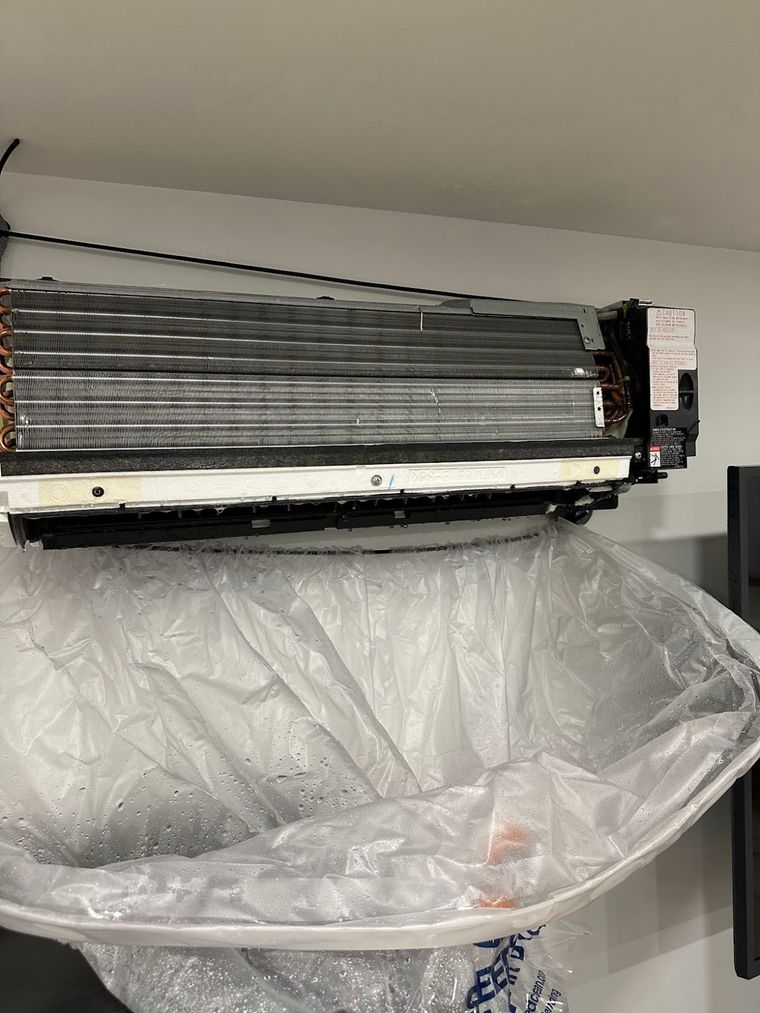
For the yearly cleaning and check, see HVAC maintenance in the borough. If a unit has stopped or is dripping, start with HVAC repair; water running down the wall usually traces back to the condensate drain line.

Mini-split wall unit with its front cover removed and the indoor coil exposed, a clear plastic cleaning bag hung underneath
Cover off and a bag hung underneath: a wall unit ready for its coil to be rinsed.

Mini-Split Jobs Across Queens, Kew Gardens to Far Rockaway

Ductless jobs our crew has done in the borough lately, from central Queens down to the Rockaway Peninsula. The list is short, and every line is a real job.

Boxed Tosot split air conditioner units loaded in the back of a white work van parked by a brick building
Boxed Tosot units in the back of a work van
New mini-split wall unit lying unboxed in its plastic wrap on a vinyl plank floor, a red tool case beside it
A new wall unit, unboxed and still in its plastic
Daikin mini-split wall unit unpacked on its box on a plywood subfloor, with the remote and manual in a bag on top
A Daikin wall unit unpacked on a plywood subfloor

Central Queens

  1. Kew Gardens Hills

    • Three Tosot systems replacing old units: two for single rooms, one with two wall units
  2. Kew Gardens

    • Three Daikin systems, seven wall units in all, lines in covers outside
  3. Jamaica

    • Ductless mini-split tune-up
  4. Howard Beach

    • Old Fujitsu system with four indoor units replaced by Tosot, on new piping
  5. Far Rockaway

    • Mitsubishi outdoor unit repaired: new inverter control board
    • Mitsubishi system swapped for a Daikin with four wall units

Rockaway Peninsula

Air Conditioning Clients, in Their Own Words

All reviews on Google
★★★★★

After someone replaced my AC filter, the unit stopped working. I called the team who installed my AC two years ago. They came out within two days, diagnosed the issue, and honestly told me that the previous technician had just accidentally turned off the indoor switch. They are incredibly honest, transparent, and responsive even years after the installation. A truly reliable business—highly recommended

Fly Sky Google · May 2026
★★★★★

Hired team to clean one of my older AC units and install a new one. Did great work, very knowledgeable and answered all my questions. Will certainly use again if needed!

Matthew P. Thumbtack · May 2025

Questions Owners Ask Before Going Ductless

I live in Far Rockaway. Does Con Edison's Clean Heat rebate apply to me?

No. Electricity on the Rockaway Peninsula comes from PSEG Long Island, which runs the grid for LIPA, so the Con Edison program doesn't cover it. PSEG Long Island has its own heat pump rebate: $4,000 per home at market rate, $5,000 in a disadvantaged community or under 80% of area median income, and $7,500 under 60%. The system has to carry the whole home's heating load, sized with a Manual J, and the rebate goes through one of PSEG Long Island's participating contractors.

Can a ducted mini-split go in my attic?

Yes, and it's a tidy way to heat and cool the bedrooms on the top floor without wall units. NYC's mechanical code asks for an attic opening of at least 20 by 30 inches and, unless the unit can be serviced from that opening, a floored path to it and a level work space beside it. Because the coil sits above your ceiling, it also needs backup water protection: a second drain pan, an overflow line or a float switch that shuts it off.

Our garden co-op wants board approval. What will they ask for?

Usually an alteration agreement, the spec sheets, a drawing of where the units and lines go, and a certificate of insurance naming the co-op. Some boards add details of their own: Glen Oaks Village, for example, requires dark brown line covers on apartments on the first floor and warns that a split system may need an electrical upgrade. We prepare the package; the board decides.

Is my block in a historic district?

Only if it's inside one of the 13 districts the Landmarks Preservation Commission lists in Queens: Addisleigh Park, the two in Cambria Heights, Central Ridgewood, Douglaston, Douglaston Hill, Fort Totten, Hunters Point, Jackson Heights, Ridgewood North, Ridgewood South, Stockholm Street and Sunnyside Gardens. Forest Hills Gardens is not on that list. Inside a district, most outdoor equipment needs an LPC permit; you or your architect apply, and we prepare the drawings and spec sheets.

Mini-split heating in deep cold: how low can it go?

A cold-climate model keeps heating well below freezing, but it's sized for a design temperature, not for the coldest night on record. Clean Heat's tool puts that between 16.5°F and 17.9°F across the borough's ZIP codes, depending on which weather station a ZIP code is tied to. Sized for it, the system carries the house through nearly every winter night, and in hard cold it pauses for a few minutes now and then to defrost the outdoor coil, which is normal.

Our house is near the water in Howard Beach. Can the outdoor unit stay at ground level?

Look the house up on the NYC Flood Hazard Mapper first. If it's in the flood zone and the ground sits below the design flood elevation, a new outdoor unit has to be lifted above that height: on steel legs, a bracket on the wall or the roof. Replacing an existing unit in the same place, like for like, is treated differently, so tell us what's there now.

Old system on R-410A: should we repair it or replace it?

Repair it if one part failed and the rest is sound; repairs on a legally installed system are still allowed in New York. Replace it when leaks keep coming back or the repair would cost a big share of a new system. Swap enough of the major parts and the state counts it as a new system, which can no longer run on R-410A. Repairs start with a $200 service call, credited in full if you go ahead.

Mini-Splits for a House, a Co-op or a Rockaway Bungalow?

Tell us which rooms you want to heat and cool, your ZIP code and who sends your electric bill. We'll come out, size the system room by room and hand you a written estimate with every unit's place marked.

Book Now