Payment plan request

Get your payment plan

Check what you picked and tell us where to reach you. We confirm the price and send your financing options together with your estimate.We confirm the price and send your financing options together with your estimate.

Plan length ≈ $317/mo · 0% APR*≈ $317/mo · 0% APR*

What do you need?

We come out, check your space and give you a written price. Estimates for new systems and replacements are free.We come out, check your space and give you a written price. Estimates for new systems are free.

Where can we reach you?

No obligation. Checking your financing options won’t affect your credit score.No obligation · won’t affect your credit

*All financing is subject to credit approval. Your terms may vary. Payment options through Wisetack are provided by our lending partners. For example, a $5,500 purchase could cost $253.54 per month for 24 months, based on a 9.9% APR, or $1,833.33 per month for 3 months, based on a 0% APR. Offers range from 0 to 35.9% APR based on amount requested and creditworthiness. Not all merchants and lending partners participate in 0% interest programs. Terms range from 3 - 120 months and may vary based on merchant, lending partner, or transaction size. State interest rate caps may apply. No prepaid finance charges or participation fees. See additional terms at wisetack.com/faqs.

ART HVAC offers financing on jobs from $500 to $25,000. Payments shown are estimates for illustration, not an offer of credit.

Ductless Mini-Split Installation and Repair in Brooklyn

A ductless mini-split heats and cools a room with no ductwork: a slim unit on the wall inside, an outdoor unit in the yard or on the roof, and one hole about the width of a soda can between them. That suits Brooklyn's brownstone parlor floors, two-family houses with a tenant upstairs, frame houses near the water and co-op apartments. We install new systems, move and replace old ones, and repair and deep-clean the ones already on your walls.

Two mini-split outdoor units on a concrete pad behind a brick building with barred windows, tools on top and a Tosot side panel leaning in front
Work in progress: two outdoor units on a pad behind a brick building.
  • One room from $2,850
  • Two to five rooms $5,900–$18,000
  • Repairs $250–$900 with the $200 diagnostic credited
  • Written estimate before work starts

Four Kinds of Brooklyn Homes, Four Different Installs

Brownstones and rowhouses

Park Slope, Bed-Stuy, Fort Greene, Carroll Gardens and Crown Heights have blocks of three- and four-story rowhouses, typically heated by radiators and built without ducts. The usual plan is a multi-zone system: a wall unit on each floor, sometimes a slim ducted unit in a closet ceiling for the top-floor bedrooms, and one or two outdoor units in the yard or on the roof. The lines run inside closets or up the back wall, so the parlor floor keeps its moldings.

Sort out first: whether the boiler keeps heating the house or the mini-splits take over, and whether your block sits in a historic district.

Two-family houses

Owner on one floor, tenant on the other: give each apartment its own system, with its own outdoor unit and power from that apartment's own panel and meter. One shared multi-zone system would put all of its electricity on one Con Edison bill. Clean Heat incentives are counted per apartment, too (see the FAQ).

Detached and semi-detached houses near the water

In Marine Park, Mill Basin, Gerritsen Beach, Sheepshead Bay, Manhattan Beach and Midwood you find detached and semi-detached houses with side yards, some with ducts already in the attic or basement. Wall units suit the rooms that need them; for a whole house with sound ducts, a ducted system can be the better buy. See heat pump installation in Brooklyn.

Sort out first: the flood map. Sandy's surge flooded all of Gerritsen Beach, and City Planning has since studied Gerritsen Beach, Sheepshead Bay and Canarsie as floodplain neighborhoods. In a mapped flood zone the outdoor unit goes up, not down, so check your address on the NYC Flood Hazard Mapper first.

Co-ops and condos

Pre-war co-ops along Ocean Parkway and in Brooklyn Heights, newer condos by the water: here the building decides. Expect an alteration agreement, a board review and house rules on outdoor units, and nothing on the fire escape. We prepare the spec sheets with sound ratings, a drawing of the unit and line route, and a certificate of insurance naming the building. The board process is laid out on our Manhattan mini-split page.

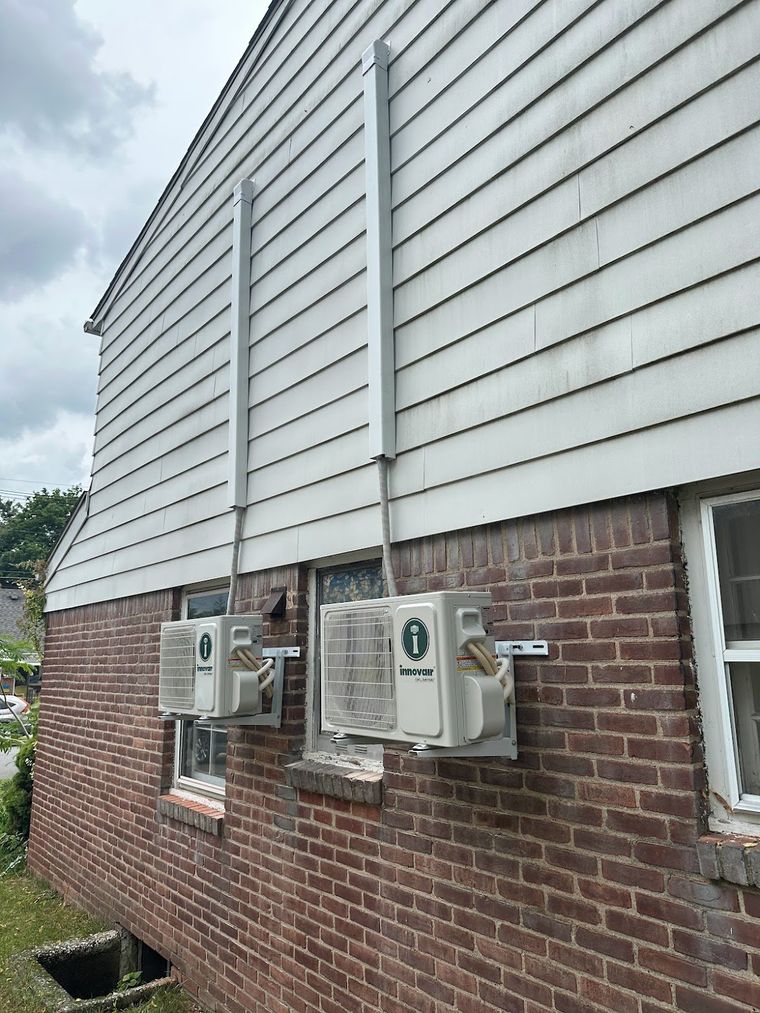
Two mini-split outdoor units on wall brackets on the side of a house with a brick lower floor and siding above
Two outdoor units on wall brackets at the side of a house: brick below, siding above.

Roof, Rear Yard or Wall Bracket: Where Your Outdoor Unit Fits

Inside, the wall unit goes where the air needs to reach. Outside is the real decision: the outdoor unit's spot sets how long the lines run, what the neighbors hear and whether the Landmarks Preservation Commission gets involved. Choose a spot on the drawing to see the details.

STREET REAR YARD SIDE YARD FLOOD LEVEL

Usually works

Rear yard

The usual home for a rowhouse's outdoor unit: a pad or a low stand near the back wall, with the lines coming down from the floors above. Easy to service, and out of sight from the street.

The neighbors
Rear yards sit under other people's bedroom windows. The city caps a single unit at 42 dB(A), measured inside the neighbor's home with the window open, so we pick a quiet model and keep it off the fence line where we can.
Snow
A stand lifts the unit above the snow line, as NYS Clean Heat asks, so the coil can breathe and defrost water can drain away.
Historic districts
LPC staff can approve yard equipment behind the house when it's set back and minimally visible from the street. A fence or a planting can do the hiding.

Every spot also has to fit the manufacturer's limits on line length and on the height between the indoor and outdoor units. We measure that on the visit, and the estimate shows where each unit goes.

Heating With National Grid Gas: Should Mini-Splits Take Over?

In Brooklyn, Con Edison delivers the electricity and National Grid delivers the gas. If your boiler or furnace burns gas, the heating bill comes from National Grid; whatever heat a mini-split makes shows up on your Con Edison bill instead.

There are two honest ways to use mini-splits in a gas-heated house:

  • Cooling, plus heat in spring and fall. The boiler stays for the coldest weeks; the mini-splits cool in summer and warm the rooms the radiators never quite reach. You keep a backup.
  • All of the heating. The system is sized for the whole house at NYC's winter design temperature, in the mid-teens, with a unit in every room that needs heat. Then the gas heat can be retired.

Con Edison's NYS Clean Heat incentives follow that choice. For a single-family house, full heating with the old system removed qualifies for $7,000 ($10,000 if the house is weatherized, $8,000 to $11,000 in disadvantaged communities). Keeping the boiler as backup, with integrated controls and the heat pump still sized for the full load, qualifies for $2,500. Mini-splits for cooling and shoulder seasons only don't qualify. Either way it's an instant discount on a participating contractor's invoice, for equipment on the cold-climate list; details in our NYC heat pump rebate guide.

Then the bill. At current prices, about $2.45 a therm for National Grid gas this winter and about 33¢ for each extra kWh from Con Edison, heat from a good gas boiler still costs less than heat from a heat pump. So the reasons to switch are cooling, even comfort and getting off gas, usually not a smaller bill. The math is in our guide to lowering your heating bill in NYC, and cold-climate performance is covered in how mini-splits handle NYC winters.

Permits, Landmarks and Install Day, in Order

A mini-split in a rowhouse or a detached house takes less paperwork than one in a co-op, but it isn't a weekend project either. Here's the usual sequence and who handles each part.

  1. Visit and room-by-room sizing

    ART HVAC

    We measure each room, look at the windows and insulation, check the electrical panel, and walk the yard and the roof for outdoor spots. Sizing comes from a heat-loss calculation, not from square feet alone.

  2. Landmarks check

    You or your architect apply; we prepare the drawings and spec sheets

    If the house is in one of the 47 historic districts and extensions the LPC lists in Brooklyn (Park Slope, Fort Greene, Cobble Hill, Stuyvesant Heights and Ditmas Park among them), almost any permanent equipment outside needs an LPC permit. Rear-yard and roof units kept out of view are a staff-level approval; a unit on the front wall goes to a public hearing.

  3. DOB filing and the electrical permit

    ART HVAC for the mechanical filing; a master electrician for the circuit

    Even for a one- or two-family house, the DOB's permit exemptions cover window and sleeve units and small systems on A1 refrigerants. New mini-splits in New York run on A2L refrigerants such as R-454B and R-32, so plan on a mechanical filing and a system test witnessed by a special inspector. The new 230-volt circuit gets its own electrical permit.

  4. Install day

    ART HVAC

    Floors get covered first. Then the wall openings, indoor units, the outdoor unit on its pad, stand or bracket, the lines, and a condensate drain to the yard, or to a small pump where gravity can't do it. A single-room system is usually a one-day job; a unit on every floor takes longer.

  5. Startup and walkthrough

    ART HVAC

    Pressure test, vacuum and charge check, then a run in heating and in cooling. We show you the remotes and how to rinse the filters, and close out the DOB filing.

Mini-Split Prices for Brooklyn Homes

Same ranges as our NYC price list. Here the house moves the number more than the brand does: how far the lines travel, what they go through and where the outdoor unit can sit.

One room, single-zone
$2,850–$7,500
Includes up to 25 feet of line set, the dedicated breaker and the mounting bracket.
Two to five rooms on one outdoor unit
$5,900–$18,000
Depends on the number of indoor units, their type and capacity.
Mini-split repair
$250–$900
The visit starts with a $200 diagnostic, which counts toward the repair if you go ahead. Refrigerant leaks are quoted once found.

What changes the price here

Line length
The price list includes 25 feet of line set. A run from the parlor floor up to the roof of a four-story house takes more.
Brick and brownstone
A clean opening through an old masonry wall takes longer than one through siding or drywall.
Condensate
A gravity drain out to the yard is simple. An inside room with no way down needs a small pump.
Electrical
Older houses can have small panels. A new circuit is routine; a panel upgrade is a separate job for an electrician.
Getting it off the ground
A raised platform in a flood zone, a wall bracket or a roof stand adds material and labor.
Hiding the lines
Lines run inside closets take more labor than a cover on the outside wall, and look better.

Every job starts with a written estimate, and nothing gets drilled before you have seen it. The full price list covers every service, and how ductless costs add up in NYC breaks down equipment and labor.

Already Have a Mini-Split? Repairs and Deep Cleaning

Plenty of the mini-split work we do in Brooklyn is on systems that are already there: units that drip, blink, or blow warm air in July. Here is what those signs usually mean.

  • Water dripping from the wall unit. A clogged drain line or pan, a condensate pump that quit, or a unit hung out of level. We clear and flush the drain, replace the pump or re-level the unit.
  • Air blows but doesn't cool or heat. Low refrigerant from a leak, a dirty coil, or a failed sensor or board. Topping up refrigerant without finding the leak only buys time; leak repairs are quoted after diagnosis.
  • Blinking lights or an error code. Often a communication fault between the indoor and outdoor units. We read the code, check the wiring between the units and replace what failed.
  • Musty smell when it starts. Dust and mold on the blower wheel and coil. That calls for a deep cleaning.
  • Stops heating for a few minutes in winter. Usually normal: the outdoor unit is defrosting. Call if it keeps cycling or ices over.

What a deep cleaning involves

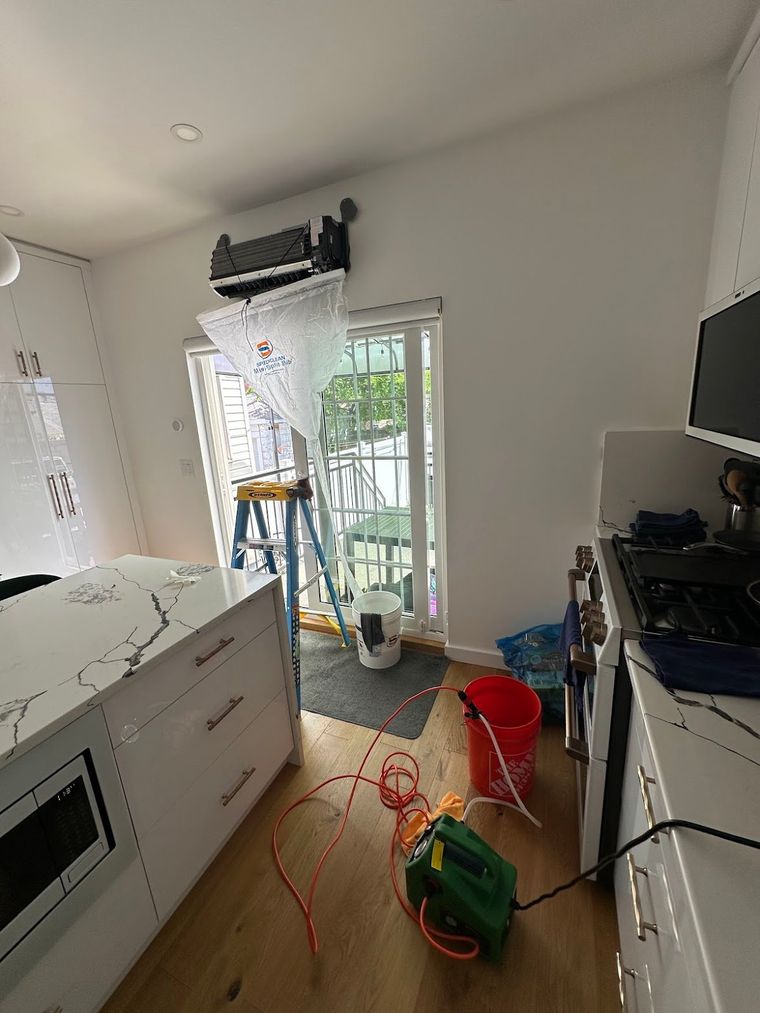
We cover the wall, hang a cleaning bag under the unit, take off the front panel and filters, and rinse the coil and blower wheel until the water runs clear, then flush the drain line and check the outdoor unit. Rinse the filters yourself as often as your owner's manual says; the deep cleaning is for what they miss.

If the drip turns out to be the drain line or the pump, see condensate drain line repair.

Mini-split wall unit above a kitchen door with a cleaning bag hung under it, a ladder and a bucket on the floor
Deep cleaning: the bag under the unit catches the rinse water.

Mini-Split Jobs From Williamsburg to Brighton Beach

Ductless jobs our crew has done around the borough over the past two years, listed north to south. Our office is on Stuart Street in south Brooklyn.

Multi-zone outdoor unit with its service cover off, showing several pairs of refrigerant line connections
Multi-zone outdoor unit with the service cover off
Ceiling cassette indoor unit mounted flush in a white ceiling above two windows
A ceiling cassette instead of a wall unit
Mini-split outdoor unit on wall brackets below a roof edge, side panel open, a disconnect box on the wall below
Outdoor unit on wall brackets, panel open for the line connections

North

  1. Williamsburg

    • Multi-zone Daikin Aurora heat pump with three concealed ducted units, replacing a Fujitsu system
    • Mini-split drain line cleaning
  2. Brooklyn Heights / DUMBO

    • Ductless mini-split cleaning
  3. Bushwick

    • Single-zone Daikin mini-split, 24,000 BTU, installed
    • Daikin multi-zone heat pump diagnosed and repaired
  4. Fort Greene / Clinton Hill

    • Ductless mini-split repair
  5. Bedford-Stuyvesant

    • Two-room mini-split maintenance
  6. Boerum Hill

    • Three-zone Daikin mini-split installed
    • Ductless mini-split repair
  7. Carroll Gardens / Red Hook

    • Multi-zone Daikin heat pump replacing an older system
  8. Park Slope

    • Mini-split deep cleaning
  9. East New York

    • Ductless mini-split repair
  10. Flatbush

    • Daikin mini-split system moved: three indoor units relocated, lines extended, new wall brackets
  11. Canarsie

    • Mini-split repair: faulty communication wiring between the units found and corrected
  12. Midwood

    • Mini-split maintenance with a deep cleaning
  13. Marine Park / Mill Basin

    • Multi-zone Tosot system installed: four wall units on one outdoor unit
    • Single-zone Tosot, 9,000 BTU, in place of an old unit
    • Fujitsu wall unit deep cleaning
  14. Brighton Beach / Manhattan Beach

    • Mini-split system repair

South

Reviews From Split-System Owners

All reviews on Google
★★★★★

My mini-split system was successfully repaired by Art HVAC from New York. Huge thanks to the entire team for their professionalism, prompt service, and friendly attitude! I'm very satisfied with the quality of the service and will definitely reach out again if needed. I highly recommend Art HVAC to anyone looking for reliable and skilled air conditioning repair and installation services in New York.

Cleaning LAB Manager Google · Jun 2025
★★★★★

Artem is an extremely knowledgeable and helpful contractor, he walked me through entire process of resolving the issue and explained step by step of what needs to be done with my split AC unit. Highly recommend this company!

Slava Lenchine Google · May 2026
★★★★★

Excellent Service and extremely knowledgeable, this team is amazing and fixed our Daikin system, i would def use again.

Boris Shapiro Google · Dec 2025

Mini-Split Questions From Brooklyn Homeowners

Can the outdoor unit go under my brownstone stoop?

Sometimes. On a landmarked block, LPC staff can approve equipment in the front areaway only when there's no practical alternative and the unit stays hidden or minimally visible, for example behind the areaway wall. Outside historic districts LPC rules don't apply, but the space is tight. The rear yard or the roof is usually easier.

Two-family house: does each apartment need its own system?

Usually, yes: its own outdoor unit and controls, powered from that apartment's own panel and meter, so each household pays for its own heating and cooling. If the mini-splits fully replace oil or gas heat, NYS Clean Heat counts each apartment at the apartment rate, $3,500 each from Con Edison (more for weatherized homes and in disadvantaged communities), as an instant discount on a participating contractor's invoice.

My house is in a flood zone. Where should the outdoor unit go?

Up. On an existing house in a mapped flood zone, NYC's flood code doesn't allow new equipment below the design flood elevation where there was none before, so the unit goes on a raised platform, a wall bracket or the roof. Check your address on the NYC Flood Hazard Mapper; the city goes by the stricter of FEMA's current and preliminary maps.

Will the neighbors hear a unit in my rear yard?

Inverter units are quiet, but rowhouse yards are close together and sound bounces off brick. NYC limits a single outdoor unit to 42 dB(A), measured inside the neighbor's home with the window open, and all of one owner's units on a lot to 45 dB(A) together. We choose the model and the spot with that in mind.

Can mini-splits replace my National Grid gas boiler?

Yes, if they're sized for the whole house at NYC's winter design temperature, in the mid-teens, with a unit in every room that needs heat. Or keep the boiler for the coldest weeks. Know the math first: at this winter's prices, heat from a good gas boiler costs less than heat from a heat pump, so the reasons to switch are cooling, comfort and getting off gas.

Does a mini-split in my house need a permit?

Plan on one. Even for a one- or two-family house, the DOB's exemptions cover window and sleeve units and small systems on A1 refrigerants, and new mini-splits in New York use A2L refrigerants. So: a mechanical filing and a system test witnessed by a special inspector, plus an electrical permit from a master electrician for the new circuit, and an LPC permit in a historic district. We handle the DOB filing.

Why is my mini-split dripping water inside?

Most of the time it's the condensate: a clogged drain line or pan, a pump that quit, or a unit hung out of level. A very dirty coil can also ice up and drip as it thaws. Turn it off, wipe the wall dry and call; the fix is usually a cleaning and a flush, sometimes a new pump.

Planning Mini-Splits for a Brooklyn House?

Tell us how many rooms, what heats the house now, and whether it sits in a historic district or a flood zone. We'll look at the yard and the roof, size the system room by room and hand you a written estimate.

Book Now