Do Mini-Split Heat Pumps Work in NYC Winters? Cold-Weather Performance, Settings & Fixes
Oct 19, 2026 12 min read Alex Weber
Quick Read
This article covers:
Whether mini-splits work in cold weather, and the one spec that decides it
How standard and hyper-heat models compare at 5°F
Seven reasons a mini-split stops heating, and which you can fix yourself
Winter settings that keep a room warm without wasting power
When a heat pump can be your only heat in NYC
Estimated read time: 12 min.
Short Answer: Yes, If You Have a Cold-Climate Model
Yes. Mini-splits work in cold weather, including a New York January, if the unit is a cold-climate (hyper-heat) model. These are rated to deliver their full heating capacity at 5°F and to keep running well below zero. A standard mini-split still heats below freezing, but its output falls as the temperature drops, so it can lose ground on the coldest nights.
Three conditions come with that yes. The unit is sized for the room at winter temperatures, not only for July. The outdoor unit sits where snow and ice can’t smother it. And the filters stay clean and the refrigerant stays sealed in. Miss one and even a hyper-heat unit feels weak.
How a Heat Pump Pulls Heat From Freezing Air
It sounds backwards, but 20°F air still holds plenty of heat. Air only runs out of it at absolute zero, around −460°F. A heat pump in cold weather works like a refrigerator turned inside out. Cold refrigerant in the outdoor coil soaks up heat from the outside air, the compressor squeezes it until it is hot, and the indoor unit releases that heat into your room.
The colder it gets, the harder the compressor works, so output and efficiency both drop. COP, the coefficient of performance, tracks the efficiency side: a COP of 2 means two units of heat per unit of electricity, twice what a space heater gets. HSPF2 averages a whole season, so it says little about your coldest night.
An inverter compressor lets a mini-split slow down instead of switching off, so in winter it runs long and steady, where it is most efficient. More in our explainer on how a heat pump works.
Standard vs. Hyper-Heat Mini-Splits: What Changes Below Freezing
In July you can’t tell the two kinds of mini-split apart. A standard model is built mainly for cooling and mild-weather heat: Mitsubishi’s own spec sheets show standard wall units keeping about 55% to 70% of their rated heat at 5°F, and many are rated to heat only down to about 5°F. A cold-climate model, sold as hyper-heat or under names like H2i or XLTH, is built to push harder in the cold and rated to hold 100% of its heating capacity at 5°F.
The independent yardstick is the cold-climate heat pump list kept by NEEP, the Northeast Energy Efficiency Partnerships. A listed model has to reach a COP of at least 1.75 at 5°F, and New York’s Clean Heat incentives use the same list.
Best Mini-Split for Cold Climate? How the Cold-Climate Heat Pump Lines Compare
Model line
Heat output at 5°F
Rated to heat down to
Mitsubishi Hyper-Heating (H2i)
100% of rated capacity
−13°F
Mitsubishi H2i sumo
100% (full output down to −10°F)
−22°F
Fujitsu AIRSTAGE Orion XLTH
100% of rated capacity
−15°F
Fujitsu AIRSTAGE Orion XLTH+
100% (full output down to −15°F)
−22°F
Daikin Aurora
Up to 100% of rated capacity
−13°F
Typical standard mini-split
About 55% to 70%
About 5°F, some to −4°F
Manufacturer ratings, checked October 2026. The standard row comes from Mitsubishi’s GL, GS, GX and WX spec sheets. Confirm the exact model on the NEEP list.
How cold does it actually get? In most winters, Central Park’s coldest night lands between the low single digits and the mid-teens, and it hasn’t dropped below 0°F since February 2016. Any cold-climate line handles that easily. The unit that runs out of breath is usually a standard one sized for summer. Our pages on Mitsubishi Hyper-Heat systems, Fujitsu XLTH heat pumps and Daikin cold-climate models cover the specific units we install.
Mini-Split Not Heating? 7 Winter Causes
When a mini-split in cold weather stops keeping up, we check these in order, starting with what you can fix yourself.
1. It’s in a Defrost Cycle (Normal)
On cold, damp days frost builds on the outdoor coil, and the unit reverses for a few minutes to melt it. Indoors the fan stops, and on some models the operation light flashes. Outdoors you may see steam. Heat comes back by itself, usually within 5 to 15 minutes. Our guide to cold air on a heat call explains the defrost cycle and how to spot one that has failed.
2. Dirty Filters or Indoor Coil
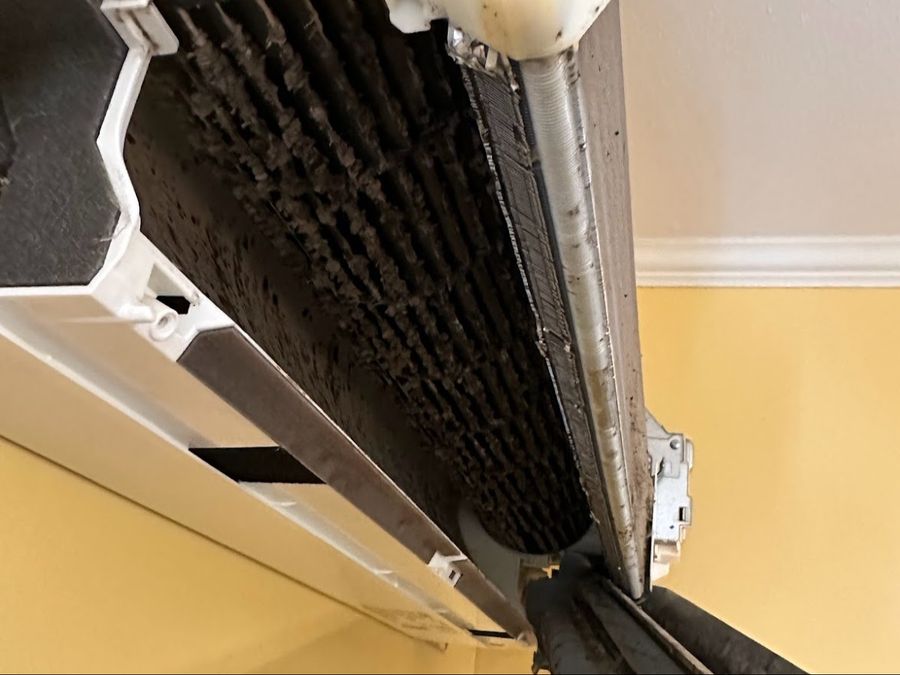
Filters clog faster in winter than people expect, because the unit runs far more hours. Less airflow means less heat. At least once a month in heating season, slide them out, rinse them in lukewarm water, let them dry and put them back. If airflow is still weak, shine a flashlight into the outlet: a blower wheel furred with dust or a matted coil needs a professional cleaning. Spraying it yourself pushes the dirt deeper and can flood the drain pan.
Behind the filters: a blower wheel and coil caked with dirt. Rinsing the filters doesn’t reach this layer; a professional cleaning does.
3. The Outdoor Unit Is Buried in Snow or Ice
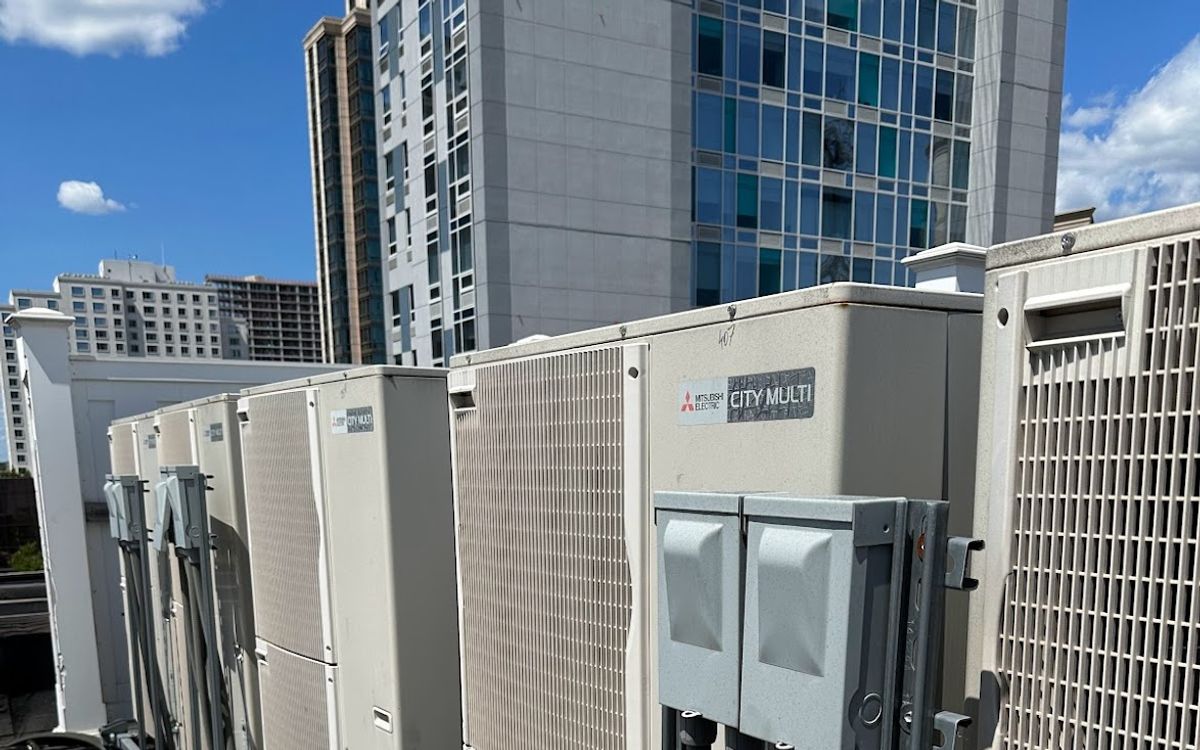
A unit buried in a drift, or under ice dripping off a roof edge, can’t pull in enough air to heat. Brush the snow away with a broom, never a shovel blade, and let ice on the fins melt rather than chipping at it. Ice that stays solid after a defrost cycle is a service call. The lasting fix is placement: a wall bracket or stand at least 18 inches off the ground, as NYS Clean Heat recommends, away from roof drip lines. Many cold-climate models add a base pan heater so meltwater can’t refreeze inside.
4. Wrong Mode or Remote Settings
AUTO can switch a unit to cooling on a sunny afternoon, DRY does almost nothing for heat, and a remote with weak batteries can quietly stop talking to the unit. Check for HEAT, a setpoint a few degrees above the room, and no timer switching it off. On a multi-zone system, one outdoor unit can’t heat and cool at once, so a head set to the opposite mode goes on standby, sometimes with a blinking light.
5. The System Is Undersized for the Room
A head that cools a living room fine in July can fall short in January, because in many New York apartments the heating load is the bigger one: old windows, exposed brick, a top floor under the roof. The giveaway is a unit running flat out on the coldest days without reaching the setpoint. No setting fixes that. A winter Manual J load calculation does, sometimes followed by a second head or a bigger outdoor unit.
6. Low Refrigerant
A mini-split never uses refrigerant up, so a low charge means a refrigerant leak, usually at a flare joint where the line set meets a unit. Signs: it runs nonstop with barely warm air, frost covers part of the outdoor coil or the service valves, or a fault code appears. Topping it off only buys time. Refrigerant work must be handled by an EPA 608-certified technician, who finds and repairs the leak, pulls a vacuum and weighs in the correct charge.
7. Error Codes and Blinking Lights
A unit that detects a fault shuts down and flashes a light, or shows a code on the remote or wall controller. On many models the number of blinks is the code. Write it down, then reset once: off at the remote, power off at the breaker for a few minutes, back on. If the same code returns, leave it off and call. Repeated resets hide the problem without fixing it.
Four Things Not to Do in a Cold Snap
Don’t chip ice off the outdoor coil; the fins bend and puncture. Don’t wrap a running unit in a tarp or keep resetting one that throws the same code. Never heat with a gas oven. A space heater goes straight into a wall outlet, never an extension cord, away from curtains and bedding.
Best Mini-Split Settings for an NYC Winter
Winter mini-split heating settings come down to one idea: let the inverter run steady. It is most efficient at low speed, and least efficient clawing back a cold room at 6 AM, near the coldest part of the day. Here is what we tell our customers.
Setting #01
1. Pick One Temperature and Leave It
Pick a comfortable temperature, around 68°F to 72°F for most people, and keep it day and night. Reheating a cold apartment forces the unit to full speed in the coldest hours.
Start at 70°F and adjust a degree at a time
Overnight, a degree or two lower at most
Cranking the setpoint up only overshoots
Setting #02
2. Use HEAT, Not AUTO
AUTO lets the unit choose between heating and cooling, and in a sunny room or next to a hot radiator it can flip to cooling. Pick HEAT for the season and leave it.
HEAT on every head of a multi-zone system
Skip DRY, which is a cooling mode
Fan on AUTO for everyday use
Setting #03
3. Point the Vanes Down
Warm air rises, so a louver aimed at the ceiling leaves your feet cold. Aim it at the floor in heating mode. Many units do this on their own unless the vane was fixed in place.
Down for heating, level for cooling
Keep curtains and furniture clear
On floor consoles, keep the lower outlet open
Setting #04
4. Let the Remote Read the Room
Most units read the temperature at the indoor unit, high on the wall where the air is warmest. If your remote can read it where you sit, a feature often labeled I FEEL or FOLLOW ME, turn it on.
Keep the remote away from radiators and sunny windows
A wall controller does the same job
No such feature? Set it a degree higher
Setting #05
5. Use Low-Heat Mode When You Travel
Don’t switch the heat off for a week away, especially with water pipes along an outside wall. Many units have a low-temperature mode, often called minimum heat or 10°C HEAT, that holds the room around 50°F for very little electricity.
Holds about 50°F instead of your setpoint
Protects pipes and houseplants
Switch back to HEAT before you return
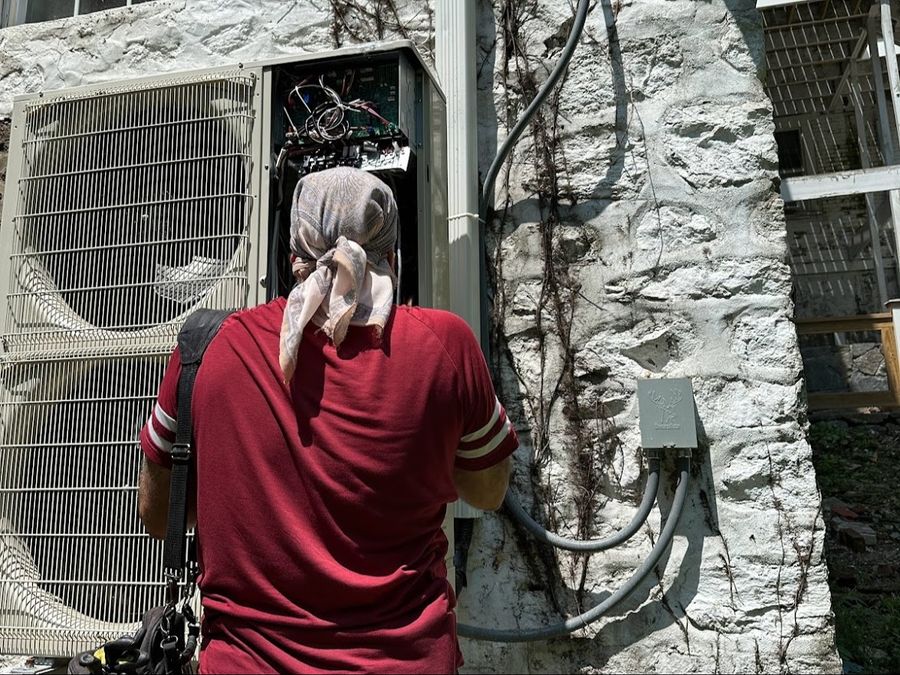
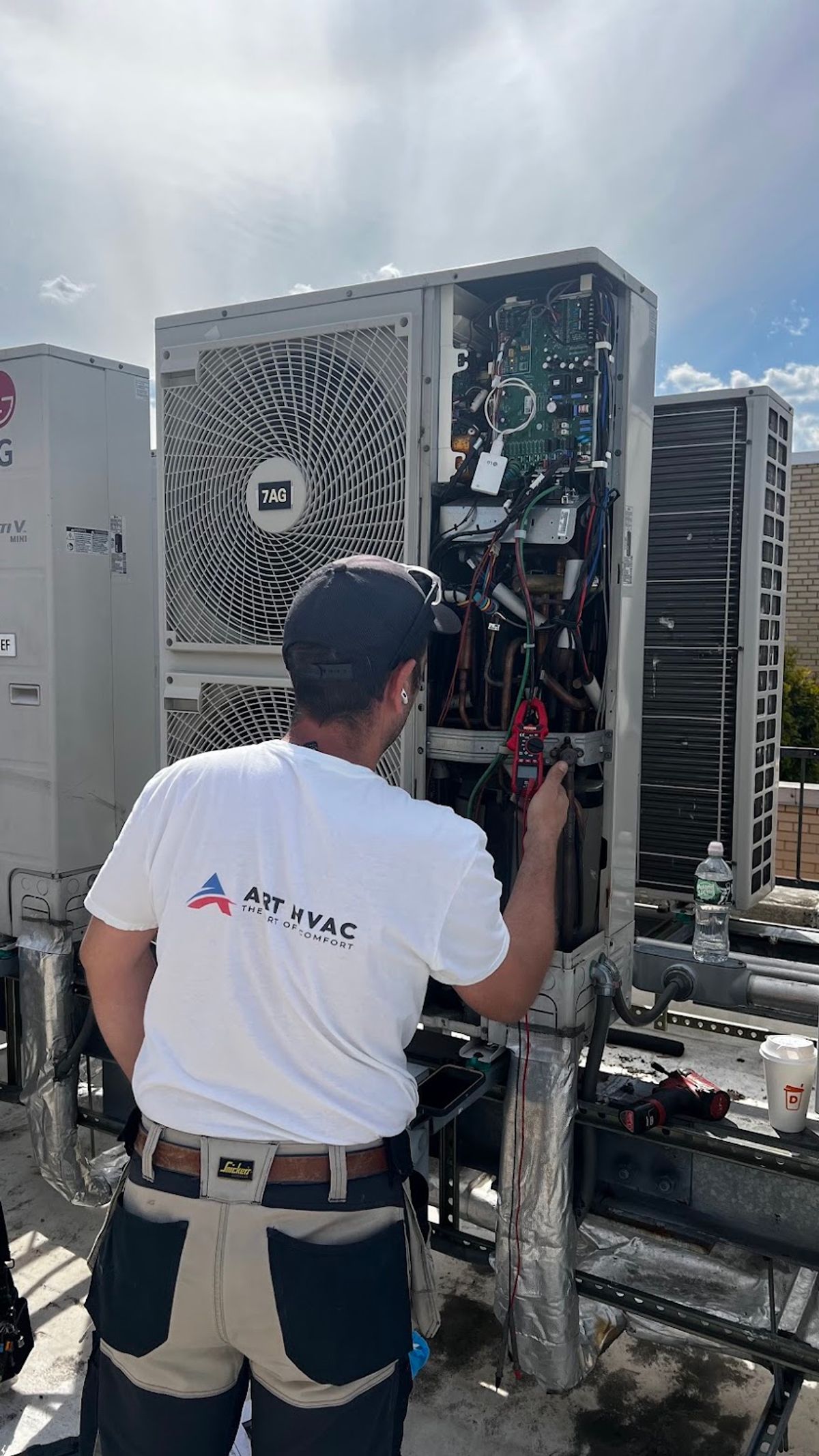
A multi-zone heat pump outdoor unit with the service panel off. Faults, sensors and refrigerant pressures get checked here, not at the remote.
Do You Still Need Backup Heat in NYC?
In most pre-war apartment buildings the decision is made for you. The boiler and radiators are the heat, and from October 1 through May 31 the owner must keep every apartment at 68°F or warmer by day when it is below 55°F outside, and at 62°F or warmer at night. Those heat season rules apply with or without a mini-split, which here is a supplement: it covers the weeks before the boiler starts, warms a cold corner room and gives you control a radiator never did.
In a house or townhouse with its own boiler or furnace, you get to choose. A properly sized cold-climate system can heat the whole home alone, the design Con Edison pays the most for. Or the heat pump carries most of the season and integrated controls hand over to the boiler below a set outdoor temperature. Our comparison of heat pumps vs. a boiler or furnace covers running costs. Electric baseboards? Leave them in place for the coldest nights.
A Heat Pump Alone Is Enough When
Every room that needs heat has its own head
It was sized with a winter Manual J calculation
The units are cold-climate models on the NEEP list
Outdoor units sit well above the snow line
Keep Backup Heat When
One head has to heat several closed-off rooms
The units are standard models sized for cooling
A top-floor corner unit loses heat on several sides
The boiler is sound and you want a safety net
Upgrading to a Cold-Climate Heat Pump: Rebates & Timing
If your mini-split struggles every January, or you want off an aging boiler, a cold-climate heat pump is the upgrade. Four things to know first.
Size it before you shop. A room-by-room Manual J for winter sizes each head and outdoor unit, and the brand comes second. Our guide to the best mini-split brands for NYC apartments compares the options.
Check the incentive before you sign. Since September 1, 2026, NYS Clean Heat in Con Edison territory pays $7,000 for a single-family home or $3,500 for an apartment when a full-load cold-climate heat pump replaces fossil-fuel heat. Homes built after 2010 or already weatherized through a utility or NYSERDA program get $10,000 or $5,000, and Disadvantaged Community addresses get more. Keeping the boiler as backup, with integrated controls, pays $2,500 or $1,000. The incentive comes off a participating contractor’s invoice and is capped at 70% of project cost. The federal tax credit ended in 2025. More in our NYC heat pump rebates guide.
Budget for the whole job. A single-zone cold-climate system usually runs $4,000 to $6,500 installed in NYC before incentives. Electrical work and long line-set runs add to it. Here is what a ductless system costs in NYC by configuration.
Pick your season. Spring and early fall are easier than winter, because the old heat isn’t needed and a co-op board has time to approve the work. Struggling this January? Get the quote now and book the install for spring.
* Typical NYC ranges in 2026. The diagnostic fee is waived if you go ahead with the repair. Installed prices are before incentives. Planning ranges, not a quote.
MINI-SPLITS IN AN NYC WINTER
Frequently Asked Questions
Find answers to common questions about our HVAC, plumbing, and refrigeration services.
It depends on the model. Standard mini-splits are typically rated to heat down to about 5°F, some to −4°F. Cold-climate lines go much lower: Mitsubishi H2i to −13°F, Fujitsu Orion XLTH to −15°F, and the newest models from Mitsubishi, Fujitsu and Samsung to −22°F. New York City rarely gets near those numbers. The more useful figure is how much heat a unit still delivers at 5°F, shown on the NEEP cold-climate list.
Most often the remote is on AUTO, COOL or FAN instead of HEAT, the unit has just started and is warming its coil, the filters are clogged, or it is coming out of a defrost cycle. If it blows cool for more than 15 minutes in HEAT mode, stays iced over outside, or keeps blinking a light, call a technician. Low refrigerant and failed sensors look the same.
No. Leave it on and, at most, set it a degree or two lower overnight. NYSERDA notes that sudden changes of 3°F or more can push a heat pump into an inefficient mode. A switched-off apartment cools down, and in the morning the unit has to run flat out in the coldest hours, when it is least efficient.
Yes, if it is designed for it. One living-room unit won’t heat closed-off bedrooms, because warm air doesn’t turn corners well. A whole-apartment system means a head in each room that needs heat, cold-climate models and a room-by-room load calculation. In pre-war buildings with steam heat, the radiators usually stay.
No. NYSERDA’s guidance is plain: a heat pump should not be covered in winter, because the outdoor unit runs all season and needs open airflow. What helps is a spot away from the roof edge or a snow shield above the unit, a bracket or stand above drifting snow, and a broom after storms.
Mini-Split Not Keeping Up This Winter?
Tell us what the unit is doing and what you’ve checked. We read the fault codes, check the filters, coil, refrigerant charge and outdoor unit, and tell you straight whether it needs a repair, a better setting or a cold-climate replacement.