
HVAC Repair in Manhattan: Fan Coils, Closet Heat Pumps, PTACs and Splits
HVAC repair in Manhattan starts with a question a house never raises: is the trouble in your unit, or in the building it's connected to? A fan coil under the window runs on water the building heats or chills. A heat pump in the closet trades heat with the building's water loop. A PTAC sits in a sleeve that belongs to the wall. We repair all of them, plus split systems in apartments and rooftop units over offices, shops and restaurants, and we work within your building's rules, from the service elevator to the shutoff valves.

- $200 service call, credited in full toward the repair
- Closet heat pump or mini-split repair: $250–$900
- PTAC or split AC repair: $250–$700
- Fan coils and rooftop units: quoted on site
Window, Closet or Ceiling? Find the Unit That Stopped
An apartment or office here can be heated and cooled by any of six kinds of unit, and the easiest way to tell them apart is where they sit. Each meets the building somewhere: the riser valves, the water loop, the wall sleeve, the drain or the roof. That line decides whether your first call goes to us or to the super.
Fan coil unit on the building’s hot and chilled water
A cabinet under the window or in a corner, a grille on top and pipes rising from the floor. No outdoor unit and no compressor: the building’s boiler and chiller make the heat and the cold, and your unit blows room air across their water.
Where it usually fails
-
Control box and transformer
The fan and the valve run on 24 volts from a small transformer. When it fails, nothing happens at all. Daikin’s fan coil manual checks it right after the breaker and the unit switch.
-
Fan motor
Power from the transformer and the thermostat, and still no fan: the motor or the whole fan assembly is next.
-
Control valve and actuator
The fan runs but the air stays at room temperature. Power at the actuator and no movement means the actuator has failed.
-
Drain pan and overflow switch
A clogged pan or drain overflows in cooling; an overflow switch, where one is fitted, stops the unit first. The makers’ test: pour water into the pan and watch it drain.
The building’s side
The risers, the plant and the valves where your unit branches off. In a two-pipe building the risers carry hot or chilled water, never both, so around each switchover your fan coil can only give what the building is sending. If the neighbors’ units do the same, it’s the building’s schedule.
On the repair visit
We test in the manual’s order: power, transformer, thermostat, fan, valve. A valve or coil repair needs the water to your unit shut off. The super does that, or shuts the whole riser if a valve won’t close tight.
From our jobs Chelsea: a fan coil’s failed 24-volt transformer replaced and the controls tested.
Fan coil repair Quoted on site Priced once we know the part. The visit is a $200 service call, credited in full toward the repair.
Filters and drain pans between repairs: maintenance in the boroughWater-source heat pump in a closet
A tall cabinet behind a closet door, or a flat one above a hallway ceiling, with hoses to the building’s pipes. It hums when it runs but has nothing outside: it trades heat with the building’s water loop.
Where it usually fails
-
Control board and fault light
A tripped safety switch stops the compressor, and the board blinks a code. The table further down explains the common ClimateMaster codes.
-
Strainer and hoses
A strainer on the inlet catches grit from the loop. When it clogs, the unit gets too little water and trips on pressure.
-
Drain pan and overflow sensor
A blocked drain, too little slope or a dusty filter lets the water rise in the pan until the sensor stops the unit.
-
Blower and filter
A dirty filter starves the coil of air: in cooling the coil gets cold enough to trip a sensor, in heating the pressure climbs.
The building’s side
The loop water: its temperature and how much of it flows, set by the building’s pumps, cooling tower and boiler. If your neighbors’ units trip on the same hot afternoon, tell the building engineer.
On the repair visit
We read the stored code, measure the water going in and coming out, and clean the strainer. The building closes the valves before the water side is opened.
From our jobs Upper West Side: dirty water from the building had clogged a unit’s strainer and hoses. We cleaned the strainer, replaced the hoses and flushed the unit.
Closet heat pump repair $250–$900 Heat pump repair on our price list. A new chassis or unit is quoted on site.
Repair, chassis swap or replacement: closet units in detailPTAC or PTHP in a wall sleeve
A wide unit under the window with a grille on the outside wall. 208/230-volt models plug into an outlet beside it; 265-volt models are wired in or sit on a power base. A PTHP also heats with its compressor.
Where it usually fails
-
The plug
Its safety plug has TEST and RESET buttons and trips on power-line disturbances, overheating or a pinched cord. Press RESET once. If it won’t latch or trips again, unplug it and call: a damaged cord is replaced, never repaired.
-
Filters
Clogged filters cut heating, cooling and airflow. Friedrich asks for them to be cleaned at least every 30 days.
-
The sleeve
Water dripping into the room points to the sleeve, which should tilt slightly outward, never toward the room. Dripping outside on a humid day is normal.
-
Heater and compressor
When power comes back, the compressor waits about three minutes, by design. Friedrich’s heat pump models switch to electric heat at about 28°F outside.
The building’s side
The sleeve and the outside grille are part of the facade, and many co-ops and condos list the sleeve as the building’s. If the breaker trips more than once, the manual sends you to an electrician, not to another reset.
On the repair visit
We test the plug, read the unit’s own diagnostics, and check the heater, the compressor and how the sleeve sits in the wall.
PTAC repair $250–$700 AC repair on our price list; a PTHP is heat pump repair, $250 to $900.
Replacing a PTAC or through-wall unitDucted unit hidden above the ceiling
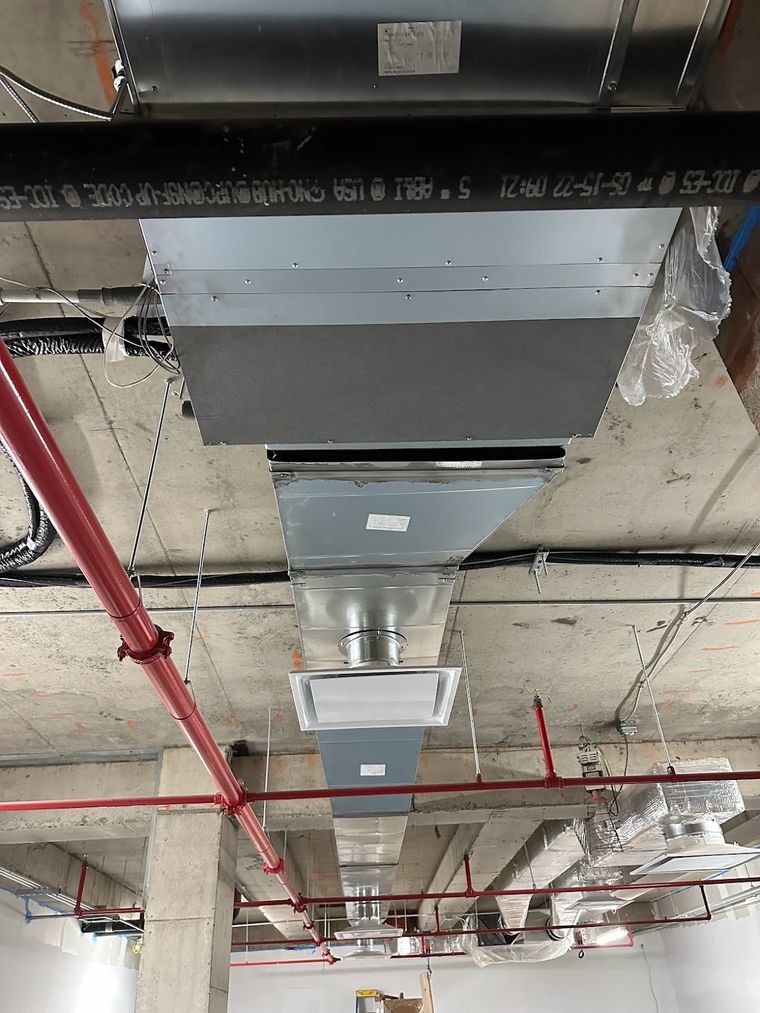
Slot diffusers or square grilles in the ceiling and an access panel in a hallway or closet. The indoor unit hangs from the slab; the condensing unit is on the roof or a terrace.
Where it usually fails
-
Condensate pump
Where no drain runs above the ceiling, a small pump lifts the water out. When it quits, the water stays in the pan.
-
Float switch and secondary pan
The backup the city’s code asks for. If the unit has stopped and its pan is full, that switch has probably done its job, and the cause is the drain or the pump.
-
Blower and filter
A clogged filter starves the coil of air, and an air-starved coil can frost over.
-
Refrigerant lines
The copper to the condensing unit. Runs outdoors can corrode and leak.
The building’s side
The drain the pump empties into, and the roof. A clog past your unit is a plumbing job, and the super and the roof rules decide when we can reach the condensing unit.
On the repair visit
We work through the access panel. If it’s too small and the ceiling has to be opened, that’s agreed with you before anyone cuts. We test the pump and the float switch by filling the pan.
From our jobs Midtown West: a failed condensate pump on a Mitsubishi ducted unit replaced through the ceiling access panel, its float switch reconnected.
Split AC repair $250–$700 AC repair on our price list. A refrigerant leak runs $250–$1,500.
Condensate pumps and drain linesMini-split wall unit with the condenser outside
A long unit high on the wall and a condensing unit on a bracket, a terrace or the roof. Several wall units can share one outdoor unit.
Where it usually fails
-
Drain and pump
Water leaves by gravity or through a small hidden pump. A slow drain or a dead pump shows up as water running down the wall.
-
Coil and blower wheel
Dust and slime build up until the water can’t reach the drain. The cure is a bag under the unit and a rinse.
-
Refrigerant circuit
A unit that runs but barely cools or heats may have a leak. We find it with a nitrogen pressure test before adding refrigerant.
-
Outdoor unit
Control boards and fan motors. On a multi-zone system, one fault outside can stop every room at once.
The building’s side
The facade, roof or terrace the condensing unit sits on. Reaching it may take the super, a roof key or a neighbor’s terrace.
On the repair visit
Units hung high need a tall ladder or a lift, so tell us the height. We start with the code on the controller and the outdoor unit.
From our jobs Chelsea: three leaking wall units, one about 12 feet up. We cleaned the coils, blower wheels and drains and replaced one condensate pump.
Mini-split repair $250–$900 Heat pump repair on our price list. Leaks are quoted after diagnosis.
Mini-splits in Manhattan: placement and paperworkPackage unit on the roof over your space
One cabinet on a curb on the roof, with ducts dropping into your ceiling; on gas-electric models, gas heat and cooling share the cabinet. The thermostat is yours; the roof may not be.
Where it usually fails
-
Inducer and pressure switch
A small blower clears the flue and a switch confirms it before the burners light. If either fails, there’s no heat.
-
Ignition and flame sensor
The igniter lights the gas and the sensor proves the flame. A dirty sensor shuts the gas off seconds after it lights.
-
Control board
It runs that sequence and the cooling side. In Chelsea we replaced a rooftop unit’s board, flame sensor and ignition rod together.
-
Compressor and contactor
A burned contactor is a small part. A failed compressor is a bigger decision.
The building’s side
The lease. NYC Small Business Services tells tenants that a unit serving only their space is likely theirs to repair, maintain and replace. The gas is Con Edison’s, and the roof is the landlord’s.
On the repair visit
Send us the make, model and serial number from the nameplate, and tell us how to get onto the roof. Commercial repairs are quoted on site.
From our jobs Midtown East: on a Trane packaged gas-electric unit, we replaced the draft inducer assembly and its pressure switch.
Rooftop and commercial units Quoted on site Depends on the unit, the part and the climb to the roof.
AC and HVAC repair across NYCWho pays depends on your proprietary lease, condo bylaws or commercial lease; the prices section below goes through it. One outdoor unit serving many indoor units is a VRF system, which has its own page.
Your Unit or the Building? What to Rule Out Before You Call
A unit can be in perfect order and still give you nothing, because the water, steam or power it runs on comes from the building. Rule that out before you book a $200 service call.
Fan coils in spring and fall: the switchover
In a two‑pipe building, one pair of risers carries hot water from the boiler or chilled water from the chiller, one at a time. A four‑pipe building has separate pipes for each.
| Two‑pipe building | Four‑pipe building | |
|---|---|---|
| The risers carry | Hot or chilled water, never both at once | Both, in separate pipes, when the boiler and chiller run |
| The unit knows by | A temperature switch on the supply pipe (an aquastat) | The thermostat opening the hot or the chilled valve |
| On a warm day in May | Heat or room air until the building switches over | Cooling, if the building is running its chiller |
Daikin’s fan coil manual spells out the two‑pipe logic: on a call for cooling, the valve opens only if the water in the pipe is below about 65°F; on a call for heat, only if it is above about 85°F. The city’s heat season runs from October 1 to May 31, so a two‑pipe building can’t simply switch to chilled water on the first warm day. Ask the super when the switchover is planned. If the neighbors have cool air and you don’t, that’s a repair.
Closet heat pumps and the water loop
Closet units trade heat with water the building circulates past every apartment. The troubleshooting table for ClimateMaster’s CXM2 control board works as a map of whose problem a trip is:
| Fault light | Causes the manual lists | Look first at |
|---|---|---|
| 2 flashes: high pressure | Cooling: too little water, or water too warm. Heating: too little air, a dirty filter or coil | Cooling: the loop. Heating: your unit |
| 3 flashes: low pressure | Heating: too little water, a plugged strainer. Also low refrigerant | The strainer at your unit, then the loop |
| 6 flashes: condensate | A blocked drain, a poor trap or slope, a plugged air filter | Your unit |
| 7 flashes: voltage | Supply voltage out of range; it clears once the voltage is back | The power, then the unit’s transformer |
The board keeps the last code even with the power off. ClimateMaster lets a locked‑out unit be cleared at the thermostat, by turning the call off and back on, or by cutting power, but warns against restarting it without fixing what tripped it. Reset once; if it trips again, leave it off and call.
Radiators and the building’s boiler
In a prewar building with steam or hot‑water radiators, the heat comes from the building’s boiler, and a cold apartment in heat season is a call to the super or the managing agent first. From 6 a.m. to 10 p.m. the city requires at least 68°F inside whenever it’s below 55°F outside, and at least 62°F overnight; if the building falls short, renters can file a heat complaint through 311. A townhouse with its own boiler is different: boiler and radiators are the owner’s, and we repair both; on the Upper East Side we fitted thermostatic valves and new air vents on one‑pipe steam radiators and skimmed the boiler. Our heat season checklist covers what a small‑building owner tests before October 1.
A gas smell or a CO alarm
Gas in Manhattan comes from Con Edison. If you smell it, leave, and once you’re outside call 911 or Con Edison at 1‑800‑75‑CONED (1‑800‑752‑6633). Con Edison warns against anything that can make a spark on the way out, phones and flashlights included. A carbon monoxide alarm is a 911 call too: NYC Health says to open the windows, get out to fresh air and let the Fire Department take the reading.
Water Through the Ceiling: Condensate Leaks Between Floors
Any unit that cools and dries the air makes water: the coil drips into a pan, and a drain or a pump carries it away. In a house, an overflow ends up on the basement floor. In an apartment building it ends up in a ceiling, yours or your downstairs neighbor’s.
What the code asks for
NYC’s Mechanical Code requires a backup wherever an overflow from a cooling coil could damage the building, which is the situation of a unit hung above a ceiling or standing in a closet over finished floors. It allows four ways to do it:
- A second pan under the unit, with its own drain to a spot where someone will notice the water.
- A separate overflow line from the unit’s own pan, connected higher than the main drain and running to a spot where someone will notice.
- A second pan without a drain, fitted with a water‑level switch that shuts the unit off before the pan overflows.
- A water‑level switch in the main pan or drain line that shuts the unit off when the drain blocks.
The code also wants drain lines that can be cleared without cutting them. Window and through‑the‑wall units are exempt from the backup rule; a PTAC sends its water to the back of the sleeve and out through drain holes or a drain kit.
If water is coming through right now
- Turn the unit off at the thermostat. A coil that isn’t cooling stops making water.
- Tell the super or the managing agent. The water may come from your unit, from the apartment above or from a building pipe, and they can get into the other apartments.
- Take photos of the ceiling, the unit and any water in its pan. Your house rules may ask for more: one co‑op on West 47th Street tells owners whose apartment is damaged to file a claim with their own insurer and notify the manager.
- Then call us about the unit. Clearing the pan and the line and replacing a pump or a float switch are repairs we do; patching the ceiling is not.
On our leak calls the cause has been a pump that quit, a drain line clogged with sludge, or a coil and pan too dirty for the water to find the drain. More on our condensate drain line page.
A Repair Visit in a Manhattan Building: Paperwork, Elevator, Shutoff, Fix
A repair in a house takes the owner and a technician. In a managed building a few more people are involved, and knowing who does what saves a wasted trip.
-
Tell us what the unit is
You
The kind of unit, what it’s doing, and the make and model from its nameplate; a photo of the label is perfect. Add the building’s name, the managing agent and any contractor rules you know about.
-
Insurance paperwork
ART HVAC
When your building asks, we send a certificate of insurance naming the building, with the managing agent listed too if they want it. One West 47th Street co‑op’s house rules, for example, ask for the co‑op and the manager to be named as additional insureds before alteration work.
-
Getting in
Doorman or super
Your building may route contractors through the service entrance and elevator and allow work only in set hours. At that West 47th Street co‑op, contractor work runs Monday to Friday, 8 a.m. to 6 p.m. We book the time with the building as well as with you.
-
Water off, if the repair needs it
Super or building engineer
Opening a fan coil’s valve or a closet unit’s hoses means closing the water to that unit first, and that’s the building’s job. Bigger shutoffs need notice: the same house rules ask for 48 hours before the heating or the main water line is shut off, and rule out shutting down the building‑wide heat from December 1 to March 31.
-
Diagnosis and a written price
ART HVAC, then whoever pays
The visit is a $200 service call. We find the fault and write up the price before any repair starts. If you go ahead with the repair, the $200 comes off the bill; if you don’t, it covers the visit and the diagnosis. In a co‑op or an office, whoever pays for the repair approves it.
-
Repair and a test run
ART HVAC
We run the unit in the mode that failed, check its drain if water was involved, and leave an invoice that names every part we replaced. Keep a copy for the managing agent if the building had to shut anything off for us.
What Repairs Cost, and Who Pays in a Co-op, Condo or Office
The ranges below are from our NYC price list. Every repair visit starts as a $200 service call, credited in full toward the repair.
- Service call
- $200
- The visit, the diagnosis and a written price.
- Closet heat pump, PTHP or mini-split repair
- $250–$900
- Sensors, fan motors, reversing valves, defrost faults. Leaks and compressors are quoted after diagnosis.
- PTAC or split AC repair
- $250–$700
- Capacitor, contactor, fan motor, thermostat.
- Refrigerant leak repair
- $250–$1,500
- Found with a nitrogen pressure test, repaired, evacuated and recharged.
- Fan coil repair
- Quoted on site
- Transformer, motor, valve actuator or drain pan, priced once we know which.
- Rooftop and commercial units
- Quoted on site
- Priced after we have seen the unit and the roof.
What changes the bill in a Manhattan building
- Access
- A unit behind a closet door is quick to reach. One above a ceiling with a small access panel, or up on the roof, takes longer.
- The building’s schedule
- Shutoffs need notice, elevators need booking, and some repairs have to wait for a window the building allows.
- Model-specific parts
- Transformers, capacitors and contactors are standard stock. Control boards, valve actuators and fan assemblies are ordered by model number, which can mean a second visit.
Who pays. In a co‑op, start with the repair clause of your proprietary lease. A common version makes the shareholder responsible for the heating fixtures and appliances in the apartment, through‑the‑wall air conditioners included, but leaves out heating and cooling equipment that is part of the standard building equipment. So a fan coil the building put in every apartment can fall on the co‑op’s side, while a split system you bought falls on yours. Condos settle it in the declaration and bylaws, offices and stores in the lease. The written price comes before any work, so whoever pays can sign off first.
Repair or replace? A closet unit with a worn‑out compressor may be better off with a new chassis, and a PTAC past saving is often replaced in the same sleeve. Both are covered on our heat pump page for the borough. Installation estimates are free, and the full price list has every range.
Recent Repairs, Uptown to Downtown: Boilers, Fan Coils and Rooftop Units
Repair jobs from our records in the borough, listed north to south. Each line names the equipment and what was fixed.


Uptown
-
East Harlem
- Boiler: water feeder replaced and air bled from the heating system
-
Upper West Side
- Unit on the building’s water: strainer cleaned, hoses replaced and the unit flushed after dirty water from the building clogged it
- Leaking refrigerant lines: corroded outdoor sections replaced, then pressure‑tested with nitrogen, evacuated and recharged
-
Upper East Side
- York system: control board, pressure switch and three‑pole contactor replaced, electric heat repaired, both coils cleaned
- One‑pipe steam heat: thermostatic radiator valves and air vents fitted, a skimming valve added and the boiler skimmed
-
Midtown West
- Mitsubishi ducted unit above a suspended ceiling: failed condensate pump replaced through the access panel, float switch reconnected
-
Midtown East
- Trane packaged gas‑electric unit: draft inducer assembly and inducer pressure switch replaced
-
Chelsea
- Fan coil: failed 24‑volt transformer replaced and the controls tested
- Rooftop unit gas heat: control board, flame sensor and ignition rod replaced
- Supply air unit above a ceiling: leaking water coil brazed, circulation pump, shutoff valve and air vent replaced
- Three leaking wall‑mounted mini‑splits: coils, blower wheels and drains cleaned, one condensate pump replaced
-
Tribeca
- Rooftop unit: control board and high‑voltage wiring replaced
Downtown
In Clients’ Words: The Repair, the Price and a Clean Job
All reviews on GoogleI'm genuinely impressed! The technician was super knowledgeable and fixed our AC unit quickly. He explained everything clearly, and the price was fair. Highly recommend their services! A+
Exceptional service. The technician was prompt and courteous and kept me updated on the progress of my repair. Very clean job, left nothing for me to do. Thank you for your excellent job.
Great service! I have used ART HVAC multiple times and they always provide excellent diagnosis and repair and a fair price
I called ART HVAC to help fix an air conditioner for a senior. Technician Art arrived quickly, diagnosed the issue, and repaired it on the spot. Very professional, polite, and efficient service. Highly recommend ART HVAC!
Manhattan Repair Questions: Fan Coils, Closets, Sleeves and Leaks
My fan coil blows room‑temperature air on a warm spring day. Is it broken?
Maybe not. In a two‑pipe building the risers carry hot or chilled water, one at a time, and the valve opens for cooling only when the water in the pipe is cold. Until the building switches over, the fan runs but can't cool. If your neighbors already have cool air and you don't, book a repair: the valve actuator, the thermostat or the switch on the pipe may have failed.
Who pays to repair the fan coil or closet heat pump in my co‑op or condo?
Your building's documents decide. A common proprietary lease clause puts appliances and through‑the‑wall air conditioners on the shareholder but leaves out heating and cooling equipment that is part of the standard building equipment, so a unit the building installed everywhere may be the co‑op's to fix. In a condo, the declaration and bylaws decide. Ask the managing agent in writing before the repair.
Water is dripping through my ceiling. Is it my unit or the apartment upstairs?
Either is possible, and so is a building pipe. Turn your unit off at the thermostat, tell the super or managing agent so they can check upstairs, and take photos. If your unit sits above the ceiling, look into its pan through the access panel: standing water points to a blocked drain or a failed condensate pump, a repair we do.
The light on my closet heat pump's control board is blinking and the unit keeps shutting off. Can I reset it?
Once, at the thermostat or the breaker. ClimateMaster warns against restarting a unit again and again without finding what tripped it, so if it shuts off a second time, leave it off and call. A high‑pressure trip while cooling can mean too little water from the building's loop; if the units next door trip too, tell the building engineer.
My PTAC is completely dead. What should I check first?
The plug. A 208/230‑volt PTAC has a safety plug with TEST and RESET buttons that can trip on a power disturbance, overheating or a pinched cord. Press RESET until it latches and give it about three minutes, since the compressor waits that long after power returns. If it won't reset or trips again, stop and call. PTAC repairs run $250 to $700 on our price list.
What does a repair visit cost in Manhattan?
It starts as a $200 service call. If you go ahead with the repair, the $200 comes off the bill; if you don't, it covers the visit and the diagnosis. On our price list, AC and PTAC repairs run $250 to $700. Heat pump repairs, closet units and mini‑splits included, run $250 to $900. Refrigerant leak repairs run $250 to $1,500. Fan coils and rooftop units are quoted on site.
Will my building let you in, and do you handle the paperwork?
We work through the building. Send us the managing agent's contact and any contractor rules, and we send a certificate of insurance naming the building when it asks for one. We book the visit inside the building's working hours and around the super, since some repairs need the water to the unit shut off first.
Do you repair rooftop units for Manhattan shops, offices and restaurants?
Yes. Recent jobs include a draft inducer and pressure switch on a Trane packaged gas‑electric unit in Midtown East and a control board, flame sensor and ignition rod on a rooftop unit's gas heat in Chelsea. Check your lease first: the city's Small Business Services guide notes that a unit serving only your space is likely yours to repair. Commercial repairs are quoted on site.
More for Manhattan Homes and Offices: Replacement, Maintenance and Guides
- Service AC and HVAC repair Central air, split systems and rooftop units across NYC
- Prices Price list Every repair and installation with its range
- Area Closet heat pumps and PTACs Repair, chassis swap or full replacement
- Area Mini-splits in the borough Where the outdoor unit goes, board paperwork, costs
- Area VRF and VRV systems One outdoor unit feeding many indoor units
- Area HVAC maintenance in Manhattan Filters, coils and drain pans between repairs
- Service Condensate drain lines and pumps Drips, clogged pans and failed pumps
- Guide Heat pump or plain AC? The one-minute test at the outdoor unit
- Guide Mini-splits in NYC winters Defrost pauses, settings and fixes
- Guide Heat season checklist Boiler checks for small building owners
- Area Every service in the borough What else we do for homes and businesses here
Unit Down in an Apartment or Office? Tell Us What Kind It Is
A fan coil, a closet unit, a PTAC, a split or a rooftop unit: say which one, what it’s doing, and send a photo of the nameplate. A repair visit is a $200 service call, credited in full toward the repair, and you see the price before work starts.