
Staten Island HVAC: Heating and Cooling for Houses, Basements and Flood Zones
HVAC on Staten Island is mostly a house question: the furnace or boiler downstairs, the ducts or radiators above it, the condenser out on its pad. Near the water there is one more: is that equipment above the flood line? On the Island we have replaced central air, a gas furnace and a gas water heater, repaired boilers and a furnace, and installed a three‑zone mini‑split. Below is what the city’s flood code allows, who supplies your gas and power, and where to go for each system.

- $200 service call, credited in full toward the repair
- Installation estimates are free
- Gas from National Grid, electricity from Con Edison
What We Do on Staten Island, System by System
Beside each system: what it covers, the range from our price list, and the page that goes into detail. The jobs we have done on the Island are listed further down.
Heating and cooling for houses
- Furnaces
Igniters, inducers, pressure switches, blowers and control boards. A new furnace, with the ducts and flue checked first, when repair no longer pays.
Repair $250–$700 Replacement $5,000–$9,000
- Boilers
Steam and hot water: pilots, circulators, expansion tanks, air vents and low‑water controls, and a tune‑up before heat season.
Repair $250–$900 Replacement $5,200–$15,000
- Central air and ducted heat pumps
Either one can use the ducts a house already has, once they are checked for leaks and size.
Central AC $5,000–$12,000 Heat pump $7,200–$18,000
- Ductless mini-splits
For additions, finished attics and houses with radiators. In a flood zone the outdoor unit goes above the line.
One zone $2,850–$7,500 2 to 5 zones $5,900–$18,000
- Water heaters
Gas and electric tanks and tankless units. In a flood zone the same height rule applies.
On the price list
- Maintenance
Spring for the cooling side, fall for the heat: coils, filters, burners and drains. Every maintenance visit ends with a written condition report.
AC tune‑up $250–$450
- Repairs
No heat, no cooling, water where it shouldn’t be, an error code: priced before the work starts.
$200 service call, credited in full toward the repair
Also asked about here
- Ducts, duct cleaning and zoning
Ducts are checked before new equipment goes on them. The guide shows what an inspection should find and when cleaning is worth it; adding zones has its own guide below.
- Air quality and ventilation
Where to start in a house, in the EPA’s order, is in the questions below.
- Commercial heat pumps and VRF
For shops, offices and larger buildings. Describe the system and the building, and we’ll say whether it is work for us.
Prices are the ranges on our price list. Installation estimates are free.
What a Staten Island House Runs On
By the Census Bureau’s count, 83% of the homes on Staten Island are in one- and two‑family buildings. Queens, next on the list, has 48%. Two thirds of the households own the place they live in. So what you have is usually the whole system, from the gas meter to the last register, and no super to call when it stops.
Gas heats 85% of the Island’s homes, the highest share of the five boroughs. About 7% heat with electricity and 4% with fuel oil. That makes the gas price the first thing to check before changing fuels. On the scale in our heating bill guide, where lower is cheaper, a new 95% furnace on National Grid gas comes to about 72 this winter and a cold‑climate heat pump to 90 to 109 on an ordinary day. A heat pump can still be the right choice when the air conditioner is due anyway and one machine can do both jobs. It just won’t be the cheaper heat this winter. Here is when to switch and when to keep the furnace.
Age is the other thing. The East Shore, South Beach to Oakwood Beach, saw a boom in new houses between the opening of the Verrazzano‑Narrows Bridge in 1964 and the early 1980s, the Department of City Planning writes, and in Sandy the water came almost a mile inland there. The flood code’s dividing date is November 16, 1983, so a house from that boom and its raised neighbor can be under different rules.
Who supplies and approves what
| Who, and what to know | |
|---|---|
| Gas | National Grid. If you smell gas, get outside, then call 911 or 1‑718‑643‑4050. |
| Electricity | Con Edison, which sells no gas here. |
| Heat pump incentives | NYS Clean Heat, run here by Con Edison: up to $11,000 for a house, as an instant discount on a participating contractor’s invoice. |
| Permits | The Department of Buildings. We handle the DOB filing. |
| Landmarks | The Landmarks Preservation Commission, for individual landmarks and three historic districts: St. George/New Brighton, St. Paul’s Avenue‑Stapleton Heights and Farm Colony‑Seaview Hospital. |
| An unused oil tank | After a switch to a heat pump it must be disabled in place or removed under the city’s Fire Code. Con Edison’s guide gives the Buildings line, (212) 639‑9675. |
The Flood Line: Where a Furnace, Boiler or Outdoor Unit May Sit
In a flood zone the city’s Building Code, in Appendix G, decides where equipment may go. FEMA’s base flood elevation (BFE) is the height of a flood with a 1% chance of coming in any year. The city adds 2 feet and calls that the design flood elevation (DFE). Pick a number on the drawing.
-
Older basement
Like for like may stay
A house finished before November 16, 1983 is “pre‑FIRM” in the code’s words. A furnace, boiler or water heater already in its basement may be replaced in kind. What may not go in below the DFE is equipment of a sort that was never there.
- Mapped in later
- A newer house is treated the same way if it was outside the flood zone when construction started and a later map put it inside.
- The half‑value line
- Work that costs 50% of the house’s market value or more, or repair after substantial damage, brings the whole house under the rules for a new one.
-
Outdoor unit
On a platform, at or above the DFE
FEMA’s brochure for homeowners asks for at least 12 inches above the BFE. The city’s 2 feet is the number that counts here.
-
Furnace or boiler
On the raised floor or higher
In a raised house the lowest floor, a basement included, has to be at or above the DFE, so the heating plant moves up with it: to a closet on that floor, or to the attic.
-
Water heater
On the raised floor or higher
The same line applies. If one has been in flood water, National Grid says to replace it, whether it runs on gas, oil or electricity.
-
Electric panel
Above the DFE and within reach
Panels and breakers go above the DFE but no more than 6 feet 7 inches off the floor, or a platform is built to reach them. This is the electrician’s part of the job.
-
Under the floor
Parking, entry, storage, crawlspace
Nothing that heats or cools belongs down here. The code’s one alternative is equipment built so that flood water can’t get into it.
From NYC Building Code Appendix G (§G102.1, §G201, §G304.1.1, §G501), 1 RCNY 3606‑01, FEMA and National Grid. The drawing is a house in an A zone; V zones and coastal A zones add rules about waves. The Department of Buildings has the last word on your house.
Planning a Replacement in a Flood Zone
Find the height before you choose the machine. A quote for the wrong spot is a quote for a job that can’t be filed.
-
Look up the address
You
FloodHelpNY, a project of the Center for New York Homeownership, shows the flood risk for an address. For building work the city uses the stricter of FEMA’s effective and preliminary maps, so the map behind your insurance may not be the one that counts.
-
Learn the height
A surveyor or engineer
A land surveyor or an engineer measures how high each floor sits and fills in FEMA’s form, the elevation certificate. In an AE zone that form is the best way to learn your base flood elevation, says FloodHelpNY. Add the city’s 2 feet and you have your line.
-
Choose the spot
You and ART HVAC
The estimate has to answer three things: what stands above that line, whether the ducts, pipes, flue and drain can reach it, and whether the old spot may still be used. Installation estimates are free.
-
File and install
ART HVAC
We handle the DOB filing. In a flood zone the plans for mechanical work carry a statement from the applicant that the equipment is placed or built to keep flood water out of it.
Jobs on Staten Island, North to South
From our records. Each stop is a ZIP code area, so the names cover neighbors too. We cover all of Staten Island from our office on Stuart Street in Brooklyn.


North
-
Todt Hill / Stapleton
- Ventilation inspection for a business: exhaust rates and inlets, ventilated work tables, HEPA filters and the HVAC system
-
New Springville / Bloomfield
- Boiler: air separator, pilot and thermocouple and expansion tank replaced, then a tune‑up
- Boiler maintenance: system flushed and bled, burners cleaned, CO2 tested
-
South Beach / Arrochar / Midland Beach
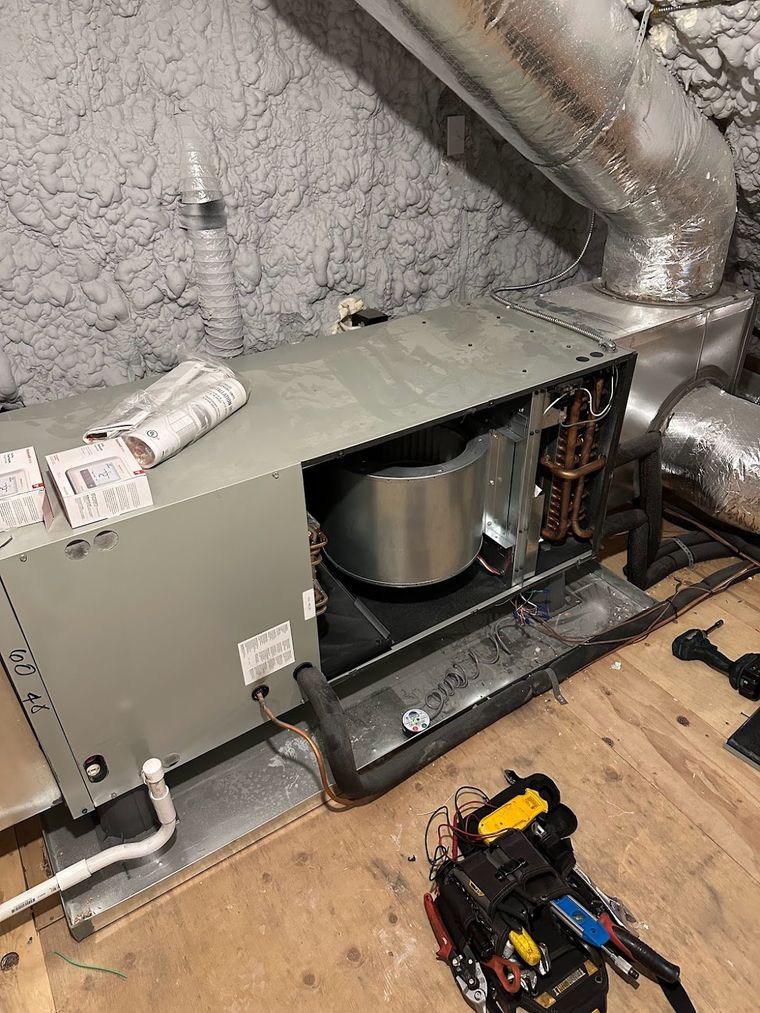
- Central system replaced: a Goodman 92% gas furnace with a 3‑ton R‑32 air conditioner and coil, on the existing ducts
- Boiler: contactor, pilot and thermocouple replaced
-
New Dorp / Oakwood
- Water heater: a 40‑gallon Bradford White gas tank replaced
-
Great Kills
- Mini‑split, three zones: outdoor unit, wall units, line sets and drains installed
-
Annadale / Rossville
- Furnace: draft motor and pressure switch replaced
-
Prince’s Bay / Charleston
- Central air replaced: a Payne 3‑ton system, condensing unit and air handler
South
Four Clients on the Work
All reviews on GoogleGreat quality and value!! Highly recommend, Art hvac was fantastic, they came on time, fixed the problem ! I will definitely use them again !
They went above and beyond to fix our central air system. I would recommend them!
The technician did an amazing job! Came very quickly and fixed everything good and fast. The furnace is back and running smoothly now!
The boiler was not working. Art came by quickly; did basic troubleshooting; discovered that the issue was a chimney clog. He climbed on the roof and inspected everything to find the culprit. He cleared out the clog and made sure everything was working perfectly. He was super nice, answered all my questions and definitely put in the extra effort. Very reasonably priced!! Highly recommend to my family and friends; I will definitely call them again when have any heating or HVAC issues!
Staten Island Questions: Basements, Ducts and Air
My basement furnace died and the house is in a flood zone. Do I have to move it upstairs?
Not always. In a house finished before November 16, 1983, a furnace that was already in the basement may be replaced there in kind, unless the project reaches half of the house’s market value or the house was substantially damaged. Raising it is still worth pricing: the same flood would take the next one too.
Will raising the furnace or boiler lower my flood insurance?
Not by much, says FloodHelpNY: machinery in the basement adds only a little to the rate. Its estimate for raising mechanicals is between $5,000 and $40,000 depending on the house and what is moved. The gain is after a storm, when heat and power can come back sooner. Ask your insurance agent about your policy first.
Is a ductless mini‑split right for a house on Staten Island?
Often for part of it: an addition, a finished attic, a converted garage, or a house with radiators and no ducts. Where good ducts already run to every room, central air or a ducted heat pump usually makes more sense. In a flood zone the outdoor unit follows the same height rule. One zone runs $2,850 to $7,500 on our price list and two to five zones $5,900 to $18,000.
Do you install basement air exchangers or whole‑house air purifiers?
Start where the EPA does: remove the source, bring in outdoor air, then filter. It suggests a furnace filter rated MERV 13, or the highest your system accepts. If the basement is damp, fix the water first and keep humidity under 60%, ideally 30 to 50%, with air conditioning or a dehumidifier. Past that, tell us about the house and we’ll tell you what we would do first; that work is quoted on site.
Will a heat pump keep up here in January?
If it is sized for the house. NYS Clean Heat’s design temperature for every ZIP code on the Island is 17.3°F, the Central Park figure, and by definition only about 1% of hours are colder. Ask to see the load calculation at that temperature. Ducted heat pumps run $7,200 to $18,000 on our price list.
Do you cover the whole Island?
Yes, from St. George to Tottenville. Our office is in Brooklyn, across the Verrazzano‑Narrows Bridge, and the list above shows the parts of the Island where we have worked.
What does a repair visit cost?
It starts as a $200 service call. If you go ahead with the repair, the $200 comes off the bill; if you don’t, it covers the visit and the diagnosis. On our price list furnace repairs run $250 to $700 and boiler repairs $250 to $900. Estimates are a different visit: installation estimates are free.
Prices, Guides and the Borough Next Door
- Prices Price list Every repair and installation, with its range
- Guide Heat pump incentives How the Clean Heat amounts are worked out
- Guide Adding zones When one thermostat isn’t enough for the house
- Guide Duct inspection What an inspection finds and how often to do one
- Area Brooklyn Where our office is
- Area Every area we serve All five boroughs and Long Island
Tell Us What Heats the House and Where It Sits
A furnace, a boiler, central air or a mini‑split anywhere on Staten Island, in the basement or above the flood line: describe it, and send the surveyor’s flood heights if you have them. A repair starts with a $200 service call, credited in full toward the repair. Installation estimates are free.