
HVAC Repair in Brooklyn: Boilers, Furnaces, AC and Heat Pumps
No heat on a cold night, or AC that runs and won't cool? Heating and cooling repair starts with what the system is doing, so the page starts there too: the usual causes, what is safe to check before you call, and what the fix costs. We repair the steam and hot-water boilers in Brooklyn's rowhouses, gas furnaces and central air in detached houses, heat pumps, and the rooftop units on small commercial buildings.

- $200 service call, credited in full toward the repair
- Boiler and heat pump repairs $250–$900
- Furnace and AC repairs $250–$700
- Itemized price before the repair starts
What Is Your Heat or AC Doing? Start With the Symptom
Pick the one closest to yours. Each panel gives the usual causes on the equipment in Brooklyn houses, what is safe to check yourself, when to stop, and what the repair costs.
The heat won't come on at all
No warmth anywhere, and often no sound from the boiler or furnace. Before it turns out to be a broken part, it is often power, gas, water or a safety switch that did its job.
Usually one of these
- Steam boiler
- The water dropped and the low-water cutoff shut the burner off, which is its job. Or the pilot or the ignition failed.
- Hot-water boiler
- A thermocouple, igniter or control board that failed, low pressure on a combi boiler, or a circulator pump that stopped.
- Gas furnace
- A dirty flame sensor, a cracked igniter, a failed inducer motor or pressure switch, or the high-limit switch tripping behind a clogged filter.
Before you call
- Thermostat on HEAT, a few degrees above the room, with fresh batteries. The service switch by the boiler or furnace on. A tripped breaker: reset it once, and leave it off if it trips again.
- Steam boiler: if the sight glass shows no water and the boiler is hot, don't add water. Cold water in a hot boiler can crack it.
- Try the stove. If it won't light either, the gas supply is the problem, and that is a call to National Grid.
Stop and call You smell gas (go outside, then call National Grid), a carbon monoxide alarm sounds, or the burner locks out again after one reset.
On the visit
We follow the heat call from the thermostat to the flame and check each safety on the way. When a boiler has shut down on low water, we also find out where the water went.
Boiler repair, steam or hot water $250–$900 Furnace repair $250–$700. Every repair starts with the $200 service call, credited in full toward the repair.
Boiler repair and replacement across NYCHeat comes up, but not everywhere
The boiler or furnace runs, yet the top floor stays cold or one radiator never warms. In a three- or four-story house the boiler is often fine; the heat just isn't getting where it should.
Usually one of these
- Steam radiators
- An air vent stuck shut, so the steam cannot push the air out; a radiator tilted the wrong way; or a failed main vent in the basement. Top floors go cold first.
- Hot-water zones
- Air trapped in the radiators or pipes, a zone valve that no longer opens, or the zone’s circulator pump has stopped.
- Ducts
- A clogged filter, blocked registers, or a duct that came apart in the attic or crawl space.
Before you call
- Hot-water radiators: bleed them with a radiator key until water, not air, comes out.
- Steam radiators: leave the vent alone and open the valve all the way. A half-open valve on a one-pipe radiator traps water.
- Ducted systems: a new filter, and nothing covering the registers or the return grille.
Stop and call Water is spraying, the boiler's relief valve is discharging, or a heat pump's outdoor unit stays a block of ice.
On the visit
We trace the heat from the boiler or furnace out to the cold room: vents, valves, zone valves, circulators, trapped air, duct joints. Finding the one part that quit is most of the work.
Furnace repair $250–$700 Boiler and zone repairs $250–$900. Every repair starts with the $200 service call, credited in full toward the repair.
Vents blowing cool on a heat call? Eight reasonsThe AC runs, but the air isn't cold
The fan blows and maybe the outdoor unit hums, but the house won't come down.
Usually one of these
- Outdoor unit
- A failed capacitor or a burned contactor, so the compressor or the fan won’t start. The unit may hum or click without running.
- Refrigerant
- Low charge means a leak. Refilling it and leaving the leak is paying for the same refrigerant twice.
- Indoor coil
- A dirty filter or coil starves it of air until it freezes; water shows up when the ice melts.
Before you call
- Thermostat on COOL, below the room temperature; the outdoor disconnect and the breaker on.
- A new indoor filter, and nothing stacked against the outdoor unit.
- Ice on the coil or the copper line: turn cooling off and run the fan alone until it thaws.
Stop and call The outdoor unit hums but its fan won't spin, something smells burnt, or the breaker trips again.
On the visit
We measure before we replace: voltage, the capacitor and contactor, airflow and the pressures on gauges. If the charge is low, we find the leak before pricing the repair.
AC repair $250–$700 Refrigerant leak repair $250–$1,500. Every repair starts with the $200 service call, credited in full toward the repair.
HVAC repair and troubleshooting across NYCWater where it shouldn't be
Under an air handler or a furnace it is usually condensate. At a boiler it is the heating water itself.
Usually one of these
- AC, air handler or high-efficiency furnace
- A clogged condensate drain, a cracked pan or a condensate pump that stopped. With the unit in an attic or above a closet, the ceiling below shows it first.
- Boiler relief valve
- A relief valve that weeps again and again on a hot-water boiler often means the expansion tank has stopped doing its job.
- Valves, vents, the boiler
- A radiator valve, air vent or fitting that weeps, or on an old boiler the boiler itself. A steam boiler that keeps needing water is losing it somewhere.
Before you call
- AC off at the thermostat; move whatever the water can damage.
- Look for a float switch on the drain line or the pan. If it tripped, the system stays off until the water is cleared.
- At the boiler, note the pressure gauge reading and whether the relief valve pipe drips.
Stop and call Water is reaching the controls or wiring of the boiler or furnace, or the relief valve is blowing hot water or steam.
On the visit
Condensate: we clear and flush the drain, replace the pump or float switch, or add a second pan under a unit above a ceiling. Boiler: we find the source and say plainly whether it is a part or the boiler.
Every repair visit $200 service call If you go ahead with the repair, the $200 comes off the bill. AC repairs run $250–$700 and boiler repairs $250–$900.
Condensate drain line repairBanging, squealing or a strange smell
Some sounds are the system working; others are a part on its way out. One smell means leave the house now.
Usually one of these
- Steam pipes banging
- Water hammer: water sitting in a pipe or radiator that has lost its slope meets the rising steam. An overfilled boiler makes it worse.
- Squeal, rattle or buzz
- A blower or fan motor with worn bearings, a loose blower wheel, a failing inducer motor, or a burned contactor on the outdoor unit.
- Smells
- Dust burning off on the first cold day is normal. A hot electrical smell, a musty smell from the vents or rotten eggs are not, and rotten eggs means gas.
Before you call
- Note when the noise happens: at startup, while running or at shutdown.
- Change the filter; a starved blower gets louder.
- Burning dust at the start of the season: run it a few minutes with a window cracked. It should fade.
Stop and call Rotten eggs: don't touch switches, go outside and call 911 or National Grid at 1-718-643-4050. A hot electrical smell or smoke: turn the system off at its switch and call.
On the visit
We find the source with the unit running. A replacement motor is often ordered for the model, and you know that before we leave.
Furnace or AC repair $250–$700 Fan and inducer motors, capacitors, contactors and igniters sit in this range on our price list. Every repair starts with the $200 service call, credited in full toward the repair.
Seasonal maintenance for boilers, furnaces and ACIt starts, stops and flashes a code
Short runs, a burner that lights and drops out, or a blinking code. Usually a safety is stopping the system on purpose, and the code says which one.
Usually one of these
- Furnace or rooftop unit
- The flame sensor can’t prove the flame, the pressure switch doesn’t see the inducer’s draft, or the high-limit trips on poor airflow. After a few tries the board locks out.
- Boiler
- The low-water cutoff dropping out, a steam pressure control set too low, or a failing control board. A combi boiler shows its fault as a code.
- Heat pump or mini-split
- Codes point to a sensor, a board or the wiring between the indoor and outdoor units. A few minutes off in winter can be a normal defrost.
Before you call
- Photograph the code or count the blinks before resetting anything.
- Reset once, the manufacturer's way or with the service switch. If it locks out again, leave it off.
- Make sure snow or debris isn't blocking the outdoor unit or the vent pipes.
Stop and call The burner flame is yellow and lazy instead of blue, the vent pipe has come loose, or a carbon monoxide alarm sounds.
On the visit
We read the fault history where the board keeps one and test the part the code points to, instead of replacing the board first.
Heat pump repair $250–$900 Furnace repair $250–$700. Refrigerant leaks and compressors are quoted after diagnosis. Every repair starts with the $200 service call, credited in full toward the repair.
Mini-split repairs and deep cleaning in BrooklynGas Smell, CO Alarm or an Overheated Boiler: What to Do First
Most heating trouble can wait for a technician. These can’t.
If you smell gas
In Brooklyn the gas is delivered by National Grid, and its instructions are short: go outside and call 911 or National Grid at 1‑718‑643‑4050. On the way out, don’t touch switches, doorbells or phones, don’t pull plugs, and don’t assume a neighbor has already called. Then wait outside for National Grid’s technician.
If a carbon monoxide alarm goes off
Open the windows, get everyone into fresh air and call 911; the Fire Department will measure the level inside. NYC Poison Control is at (212) 764-7667. At home, carbon monoxide usually comes from fuel-burning equipment that isn’t venting: a furnace, a boiler, a water heater, or a clogged chimney or exhaust vent. The first symptoms, headache, nausea and dizziness, pass easily for the flu. Leave the heat off until it has been checked.
If the boiler runs hot or won’t shut off
Weil-McLain’s owner’s manual says not to cut power to the pump, which keeps moving heat out of the boiler, and to close the gas at a valve outside the boiler instead. If a steam boiler’s sight glass is empty while the boiler is hot, don’t add water: cold water can crack a hot heat exchanger. Our guide to an overheating boiler has the steps by type of boiler.
If water got to the burner or the controls
Don’t restart a boiler or furnace whose burner, controls or wiring sat in water. The same manual says such a boiler must be replaced or completely repaired and inspected first, and that one soaked in salt water should be replaced. Worth knowing in the low-lying neighborhoods along the shore.
Detectors, if you rent out an apartment
City law puts them on the owner. In a multiple dwelling, and in the rented apartment of a one- or two-family house, a carbon monoxide detector has to be within 15 feet of each bedroom door wherever equipment burns fuel. From January 1, 2027, a natural gas detector is also required where there is gas piping. Tenants test them monthly.
What Wears Out on Brooklyn Boilers, Furnaces and Rooftop Units
Steam boilers in brownstones and rowhouses
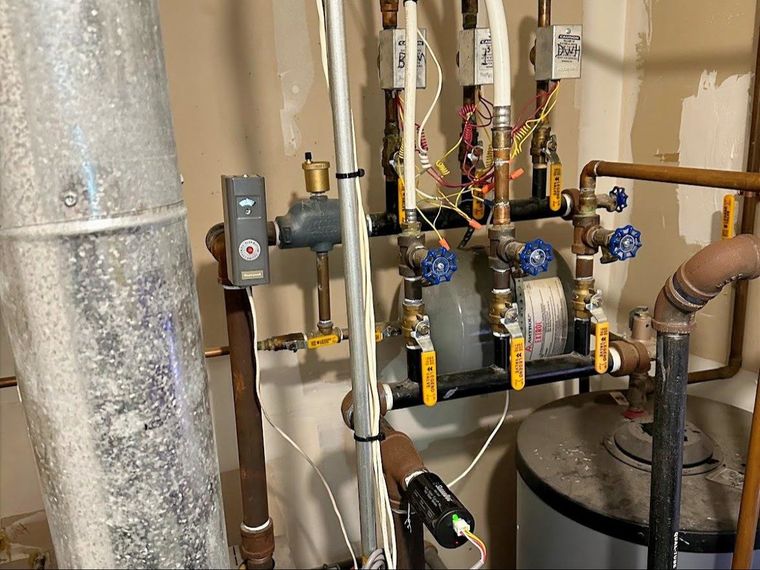
A one-pipe steam system has few moving parts. What fails is the hardware around the boiler: the low-water cutoff, the vents that let air out of the mains and radiators, the relief valve, the pressure control, and the pilot, thermocouple or ignition. Our recent boiler repairs in Sheepshead Bay included low-water cutoffs, steam vents and a relief valve. A boiler that needs water again and again is leaking somewhere, and the Weil-McLain manual warns that fresh make-up water brings in minerals and oxygen that scale and corrode a boiler from the inside.
Hot-water boilers, zones and combis
More parts move here: a circulator for each zone, or one pump and a zone valve per zone, an expansion tank, air vents, often a tank that heats the tap water off the same boiler, and in some houses a wall-hung combi boiler doing both jobs. What we end up replacing: circulators, thermocouples and ignition parts, gas valves, flue dampers, control boards, and air vents when the top floors stay cold.
Gas furnaces in detached houses
Many of our furnace calls come from Sheepshead Bay, Manhattan Beach and Gravesend, where houses with ducts are common. A furnace lights in a fixed order: the inducer starts the draft, a pressure switch confirms it, the igniter glows or sparks, the gas valve opens and the flame sensor proves the flame. Any failed step stops the burner, and the blink code says which one. More on furnace repair.
Central air and heat pumps
A burned contactor or capacitor on the outdoor unit is a short repair. A refrigerant leak takes a pressure test, brazing, a vacuum and a fresh charge. Older central air may still run on R-22, which is no longer made or imported. The EPA doesn’t require you to replace such a system, but a leak repair can only use recycled, reclaimed or previously produced R-22, so that is the moment to compare. R-410A systems are serviced as usual.
Rooftop units and mixed-use buildings
Shops and restaurants in low buildings often run a rooftop package unit with a gas furnace section. It fails the way a house furnace does, plus a heat exchanger that eventually goes; we have replaced each of these parts on rooftop units in Williamsburg and Brighton Beach. A boiler in a mixed-use building, a store with apartments above, generally needs an annual DOB inspection; a house with one to five families does not.
What a Repair Costs, From the Service Call to the Part
The ranges on our NYC price list. Every repair visit is a $200 service call. If you go ahead with the repair, the $200 comes off the bill; if you don’t, it covers the visit and the diagnosis.
- Service call
- $200
- Credited in full toward the repair if you go ahead.
- Boiler repair, steam or hot water
- $250–$900
- No heat, leaks, pressure and ignition problems.
- Furnace repair
- $250–$700
- Igniter, flame sensor, inducer motor, control board.
- AC repair
- $250–$700
- Capacitor, contactor, fan motor, thermostat. Refrigerant leak repair runs $250–$1,500.
- Heat pump repair
- $250–$900
- Defrost, reversing valve, sensors, fan motors. Refrigerant leaks and compressors are quoted after diagnosis.
- Rooftop units and commercial systems
- Quoted on site
- Depends on the unit, the part and how we get to the roof.
What moves a repair bill
- The part
- A flame sensor or a capacitor is a small part. A control board, inducer motor, circulator or heat exchanger costs more, and parts made for one brand may have to be ordered.
- Getting to it
- A cramped cellar, a crawl space, an attic or a roof with no easy access adds labor.
- More than one fault
- A furnace that overheated behind a clogged filter may also have worn out its limit switch. Anything past the first price is priced again and done only with your approval.
Repair or replace? We say so plainly when a repair isn’t worth it: a cracked heat exchanger, leaking boiler sections, a boiler that sat in flood water, a failed compressor on an old R-22 system. On the same price list a new furnace runs $5,000 to $9,000; a house boiler, $5,200 to $15,000; a whole-house heat pump, $7,200 to $18,000. There is no charge for a replacement estimate. What can take a boiler’s place is on our heat pump page for Brooklyn houses.
You get an itemized price before any repair starts. The full price list covers every service.
From Your Call to the Test Run: How a Repair Visit Goes
The usual order of a repair visit, and who does what.
-
Your call
You, by phone or the booking form
Tell us what the system is doing, what kind it is, the brand if you can see it and any code on the display. A photo of the rating plate helps us bring the right parts.
-
The $200 service call
An ART HVAC technician
We test before we replace: power and controls, gas and ignition, water and pressure, refrigerant, airflow. You hear the cause in plain words.
-
A written price
You decide
An itemized price before any repair. Go ahead, and the $200 comes off that bill; decide not to, and it covers the visit and the diagnosis.
-
Parts
ART HVAC
Common parts may be on the truck. Control boards, inducer motors, heat exchangers and other model-specific parts are ordered, and we come back to fit them.
-
Repair and test run
ART HVAC
Full cycles after the repair: ignition, flame, safeties, pressures, temperatures. On gas equipment we leak-check every connection we opened.
-
Paperwork
ART HVAC
An invoice listing what we found and what we replaced, so a warranty claim with the manufacturer has what it needs.
Recent Repairs, Williamsburg to Brighton Beach
Repairs our crew has finished around Brooklyn, listed north to south. Each line names the equipment and what failed.


North
-
Williamsburg
- Carrier rooftop unit, gas heat: draft inducer, spark igniter and pressure switch replaced
- York rooftop unit: heat exchanger and inducer motor replaced
- Rooftop unit gas section: ignition control board, gas valve, flame sensors and igniters replaced
-
Bushwick
- Gas boiler: gas valve, ignition module and flue damper replaced; air vents and circulator pump replaced on the radiator loop
-
Bedford-Stuyvesant
- Combi boiler: pressure adjusted and air bled from the system
- Boiler control relay replaced
-
Carroll Gardens / Red Hook
- Boiler flushed of scale, indirect water heater coil and tank flushed, mixing valve replaced
-
Prospect Heights
- LG Multi V VRF outdoor unit: main control board replaced, refrigerant charge checked
- Daikin ducted indoor unit: condensate pump replaced, drain pan repaired
-
Crown Heights
- Heating system: Taco circulator pump replaced
- Boiler air vent and damper replaced
-
Park Slope
- Refrigerant leak on an indoor coil brazed, system evacuated and recharged
-
East New York
- Boiler with the pilot out: thermocouple replaced
-
Brownsville
- Trane blower motor and blower wheel replaced
-
Sunset Park
- Daikin ducted fan coil: condensate pump and float switch replaced, drain pan cleaned
-
Kensington
- Daikin VRF system: refrigerant leak traced with nitrogen and an ultrasonic detector, sealed and recharged
-
Bay Ridge
- 5-ton Mitsubishi central air system: refrigerant leak found and repaired
-
Marine Park / Mill Basin
- Through-the-wall air conditioner replaced with a new LG unit
-
Bath Beach
- AC disconnect box and thermostat replaced
-
Sheepshead Bay / Homecrest
- Boiler low-water cutoff replaced
- Weil-McLain boiler: control board replaced
- Furnace: inducer motor and pressure switch replaced
- Central air: burned-out contactor and damaged wiring replaced
-
Brighton Beach / Manhattan Beach
- Furnace: inducer motor replaced
- Carrier rooftop package unit: heat exchanger replaced
- Fujitsu indoor unit: control board replaced
South
What Owners Said After the Repair
All reviews on GoogleArt HVAC repaired the boiler. It was heating the basement and ground floor but not the other two upstairs floors.
Highly recommend! My boiler had a bad leak and Artem was able to come the next morning, diagnose it, and within an hour it was fixed. Great service
Art & Stan were great. I had my furnace fixed and the price was good. Very reliable. I highly recommend them. They definitely know their business.
Can't recommend enough! The central AC unit broke. Artem came quickly, identified a leak, clearly explained the necessary repairs, and completed the work on the spot. I'm incredibly grateful for his fast, professional service especially in this summer heat. I'll definitely call Artem again when I have future HVAC issues!
Heating and Cooling Repair Questions From Brooklyn Owners
How much does a repair visit cost?
Every repair visit is a $200 service call. If you go ahead with the repair, the $200 comes off the bill; if you don’t, it covers the visit and the diagnosis. On our price list, boiler and heat pump repairs run $250 to $900 and furnace and AC repairs $250 to $700; refrigerant leak repairs run $250 to $1,500. You get an itemized price before any repair starts.
Is it worth repairing an old boiler, or should I replace it?
Usually the parts around it are worth repairing: a low-water cutoff, a circulator, an igniter, a control board. Leaking cast-iron sections, a cracked heat exchanger or a boiler that sat in flood water are where replacement makes sense. A house boiler runs $5,200 to $15,000 on our price list, and there is no charge for a replacement estimate.
Why does my steam boiler keep shutting off?
Often the low-water cutoff is doing its job: the water dropped and it stopped the burner. The question is where the water goes, usually a leaking vent, valve or return line. Dirty boiler water can also make the level jump and trip the cutoff. Weil-McLain’s manual for its gas steam boilers calls for testing the cutoff regularly through the heating season. Never add cold water to a hot, empty boiler.
I rent out a floor of my two-family house. What heat do I owe the tenant?
Under the Housing Maintenance Code, a one- or two-family house with a tenant must have heat from October 1 through May 31: at least 68°F from 6 a.m. to 10 p.m. when it is below 55°F outside, and at least 62°F overnight. Hot water must be at least 120°F. A tenant without heat can call 311, and HPD can inspect. The code also requires a carbon monoxide detector in the rented apartment if the house burns fuel. And from June 1, 2030, central air or a permanent cooling unit in that apartment must be kept able to hold 78°F or below from June 15 to September 15.
Can you still get parts for an old furnace or boiler?
Usually. Flame sensors, igniters, thermocouples, circulators, low-water cutoffs and many controls fit a wide range of equipment. Brand-specific boards and heat exchangers are ordered by model, and for older units some are no longer made. Central air on R-22 is the special case: no new R-22 is made or imported, so leaks are repaired with recycled, reclaimed or previously produced refrigerant. The EPA doesn’t require you to replace the system, but it is a good moment to compare.
Is it safe to keep running the system until the technician arrives?
Usually, yes. Leave it off if you smell gas (go outside and call 911 or National Grid at 1‑718‑643‑4050), a carbon monoxide alarm sounds, the burner locks out again after one reset, you smell hot wiring, water reaches the controls or the outdoor unit is encased in ice. If the heat is out in freezing weather, call our 24/7 Emergency Line.
Do you repair rooftop units on stores and restaurants?
Yes, rooftop package units on small commercial buildings, including the gas heating section: inducers, igniters, flame sensors, pressure switches, gas valves and heat exchangers, on Carrier and York units among others, in Williamsburg and Brighton Beach. Commercial repairs are quoted on site. If the building has a boiler and both stores and apartments, the boiler generally also needs an annual DOB inspection.
Do you fix PTACs and mini-splits too?
Yes. A PTAC, the through-wall unit under a window, gets the same diagnosis: fan motor, controls, refrigerant, or a blocked drain in the sleeve. When one is past repair, a new chassis that fits the existing 42-by-16-inch sleeve avoids opening the wall. Mini-split repairs and deep cleaning are covered on our ductless page for the borough.
Service Pages, Guides and the Rest of the Borough
- Service HVAC repair Repair and troubleshooting across NYC
- Service Boiler repair and replacement Steam and hot-water boilers
- Service Furnace repair Gas and electric furnaces, from repair to replacement
- Prices Price list Every service with its price range
- Guide Cold air on a heat call Eight causes, from the fan setting to ignition
- Guide Heat season boiler checklist The heat law, DOB inspections and boiler upkeep
- Guide Heat pump or plain AC? How to tell which one you have
- Area Mini-splits in Brooklyn Repairs, cleaning and new installs
- Area Heat pumps in Brooklyn When a boiler or furnace is due for replacement
- Area Maintenance and tune-ups What a skipped tune-up turns into
- Area All services in the borough Installs, maintenance and refrigeration work here
Heat Out or AC Down? Tell Us What It Is Doing
Call with the symptom, the kind of system and any code on the display. A visit to your Brooklyn house or business is a $200 service call, credited in full toward the repair, and you see the price before any work starts.