
Whole-House Heat Pump Installation and Replacement in Brooklyn
If your Brooklyn house heats with a boiler or a furnace burning gas or oil, a heat pump can carry that whole load and cool the house in summer: through the ducts a furnace already uses, through wall and ceiling units where there are only radiators, or by sending warm water to the radiators themselves. We size it for the house, install it, and replace or repair heat pumps that are already there.

- Whole-house installs $7,200–$18,000
- Heat pump repairs $250–$900; the $200 diagnostic counts toward the repair
- Sized for 17.3°F, the local design temperature
- Estimate in writing after we see the house
Steam, Hot Water or Ducts? What a Heat Pump Takes Over
Start with what heats the house today. It decides which heat pump fits, what stays in the basement and how much of the house gets opened up. Pick the one you have.
Steam boiler and radiators
How to tell: The radiators hiss and knock as the heat comes up, and each one has a small vent on its side. Down by the boiler, a glass tube shows the water level and the pressure gauge barely moves off zero.
- What a heat pump can do
- Steam needs water boiled past 212°F. Even a high-temperature air-to-water heat pump makes water up to about 158°F, so it can’t feed these radiators. The heat comes from air-to-air units instead: wall units, slim ducted units in closet ceilings, or ducts on the top floor.
- What stays
- Often the boiler, at least for a while. With integrated controls the heat pumps run first and the boiler covers the coldest days. Or the heat pumps are sized for the whole house and the boiler is retired.
- Check first
- Whether the boiler also makes your hot water, how the lines will reach each floor, and the roof or the yard for the outdoor units.
Hot-water boiler with radiators or baseboards
How to tell: The heat comes on quietly. Beside the boiler there is a circulator pump on the pipe and a round expansion tank, and each radiator or baseboard has a small bleed valve at the top.
- What a heat pump can do
- Two ways. An air-to-water heat pump replaces the boiler and sends warm water through the same pipes and radiators. Or air-to-air heat pumps take over room by room, and the radiators stay as backup.
- The catch
- A heat pump runs more efficiently with cooler water, and a radiator gives off less heat when the water is cooler. Whether yours are big enough is worked out room by room.
- Check first
- Whether a tank next to the boiler heats your tap water. An air-to-water system can take that job over with a tank of its own.
Gas or oil furnace with ducts
How to tell: Warm air blows from registers in the floor or the walls. The furnace in the basement or the attic has a filter slot, and with central air there is a coil box on top of it and a condenser outside.
- What a heat pump can do
- The most direct swap. A heat pump outdoor unit takes the condenser’s place, and a heat pump air handler, or a coil on the existing furnace, moves the heat through the ducts you already have.
- What stays
- The ducts, once they are tested. ENERGY STAR puts typical duct losses at 20 to 30 percent of the air they carry, and heat pump air comes out cooler than furnace air, so leaks and tight runs matter more.
- Keeping the furnace
- Possible: the heat pump runs first and the furnace takes the coldest nights. For Con Edison’s Clean Heat incentive that takes integrated controls on the existing furnace. A heat pump installed with a new furnace doesn’t qualify.
An older heat pump that is failing
How to tell: The outdoor unit runs in winter as well as summer, the thermostat has a Heat setting and often an Emergency Heat setting, and the indoor side is an air handler or wall units.
- Repair or replace
- Sensors, fan motors, boards and defrost faults are usually repairs, $250 to $900 with the $200 diagnostic credited. Compressors and refrigerant leaks are quoted after diagnosis, and on an older system that is where replacement starts to make sense.
- The refrigerant rule
- New systems installed in New York since January 1, 2026 run on lower-GWP refrigerants such as R-454B or R-32. An existing R-410A system can keep running and be serviced, but replacing enough major parts makes it count as a new system.
Keeping the Radiators: Air-to-Water Heat Pumps
If the house has hot-water radiators or baseboards, the heat pump doesn’t have to blow air. An air-to-water heat pump does the boiler’s job from outside: it pulls heat out of the outdoor air and hands it to the water in your existing pipes. The system we install for this is Daikin’s ALTHERMA 3 H HT. Daikin rates it for water up to 158°F with 5°F outside and for heating and hot water down to -18°F. It runs on R-32, and the refrigerant stays in the outdoor unit: indoors there is only water piping.
Will your radiators be big enough?
Think of a radiator as a hand warmer: the hotter the water inside, the more heat it gives off. A boiler usually runs hotter water than a heat pump likes to make, and the cooler the water, the more efficiently the heat pump runs. So we go room by room, comparing the heat each room loses on a design night with what its radiator gives at the water temperature the heat pump will run. Rooms that come up short get a larger radiator, a second one or a fan coil.
Tap water and summer cooling
The same outdoor unit heats a stainless hot-water tank, which matters if your boiler makes your tap water today. Radiators can’t cool, though. For summer you add fan coils or an air handler on the same water loop, or keep mini-splits in the rooms that need them.
Incentives and price
Air-to-water heat pumps count under NYS Clean Heat when the exact model is on the program’s qualified air-to-water list; we confirm the model before quoting. The same full-load and decommissioning rules apply as for any heat pump. We price these systems after a site visit, because the heat load, the radiators and the hot-water demand all move the number.
Still on Heating Oil? What Changes When You Switch
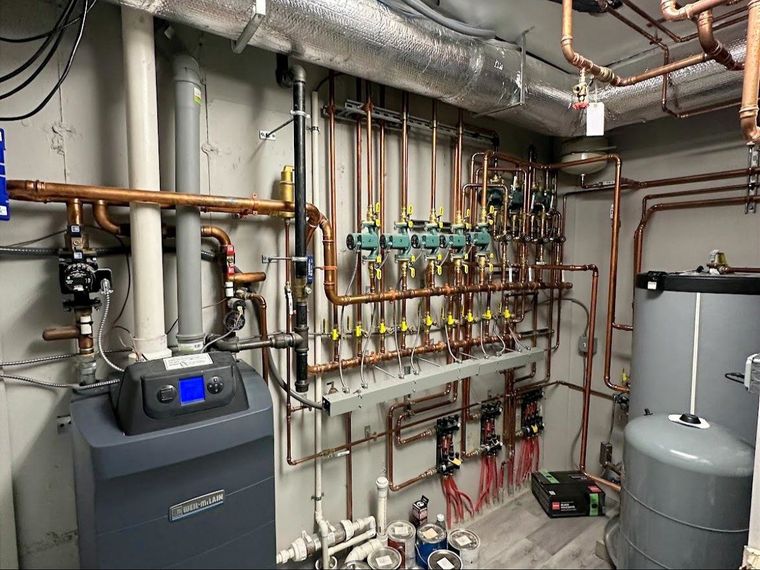
City law has already pushed the heavy oils out of NYC boilers: residual oil, No. 6, has been illegal in them since January 1, 2020, and No. 4 is banned from July 1, 2027. A house burner runs on No. 2 heating oil, which those laws don’t touch. What pushes people off oil is the bill.
| Heat source | Cost, rounded |
|---|---|
| Electric baseboard | $97 |
| Heat pump on a 5°F night (COP 1.75) | $55 |
| Oil boiler at 85%, oil at $6.16 a gallon | $52 |
| Heat pump at COP 2.5 | $39 |
| Heat pump at COP 3 | $32 |
| National Grid gas, boiler at 80% | $31 |
| National Grid gas, condensing boiler at 95% | $26 |
Read it this way: next to oil at this winter’s price, a heat pump costs less to run on all but the coldest nights. Next to National Grid gas, it breaks even at best and usually costs more. The assumptions are spelled out in our guide to lowering your heating bill in NYC. With a furnace and central air, the comparison changes: see heat pump vs. traditional HVAC.
The oil tank
Once the burner goes, the tank can’t stay as it is. In NYC a tank taken out of use after a switch to a heat pump must be disabled in place or removed under the Fire Code, and the Clean Heat program recommends removal. An oil-tank contractor does that work; we schedule the heat pump around it.
Hot water after the boiler
If the boiler also heats your tap water, through a coil inside it or a tank beside it, retiring it takes that away too. Plan the replacement with the heat pump: a heat pump water heater, an air-to-water system with its own tank, or a standard water heater. Con Edison’s discount on qualifying heat pump water heaters comes off at the store or distributor; more on our water heater installation page.
From Boiler to Heat Pump: The Conversion, Step by Step
A whole-house conversion touches the electric service, the old system and sometimes the roofline, so the order matters. This is how it usually runs, and who handles each part.
-
Heat-loss calculation
ART HVAC
We measure every room and its windows and run a Manual J heat-loss calculation at 17.3°F, the 99% design temperature the NYS Clean Heat lookup tool gives for every Brooklyn ZIP code (all of them use the Central Park weather station). In a rowhouse the shared walls lose little heat; most of it goes out through the roof, the front and back walls and the windows.
-
Electrical service check
You, your electrician and Con Edison
Heat pumps add load. NYSERDA’s guide for installers flags homes under 100-amp service, or built before 1965, as likely to need more amperage, and a Brooklyn brownstone fits that description. On a Clean Heat project Con Edison must confirm the service before installation, and any upgrade it calls for comes first.
-
Choosing the system
You decide; we lay out the options
Ducted on the existing ducts, room-by-room units, air-to-water on the radiators, or a mix, such as ducts on the top floor and wall units below. Then the second choice: keep the boiler or furnace as backup with integrated controls, or retire it.
-
Permits and landmarks
DOB filing: ART HVAC. Electrical permit: a master electrician. LPC: you or your architect
Today’s heat pumps use A2L refrigerants, which the DOB’s small-system exemption doesn’t cover, so expect a mechanical filing and a test in front of a special inspector. On a landmarked block, a roof or rear-yard unit kept out of view is a staff-level Landmarks approval; we supply the drawings and spec sheets.
-
Installation and startup
ART HVAC
The outdoor unit sits on a stand above the 6-inch snow depth the same tool lists here. Then the line sets, the air handler, indoor units or water connections, a pressure test, a vacuum and a run in heating and cooling.
-
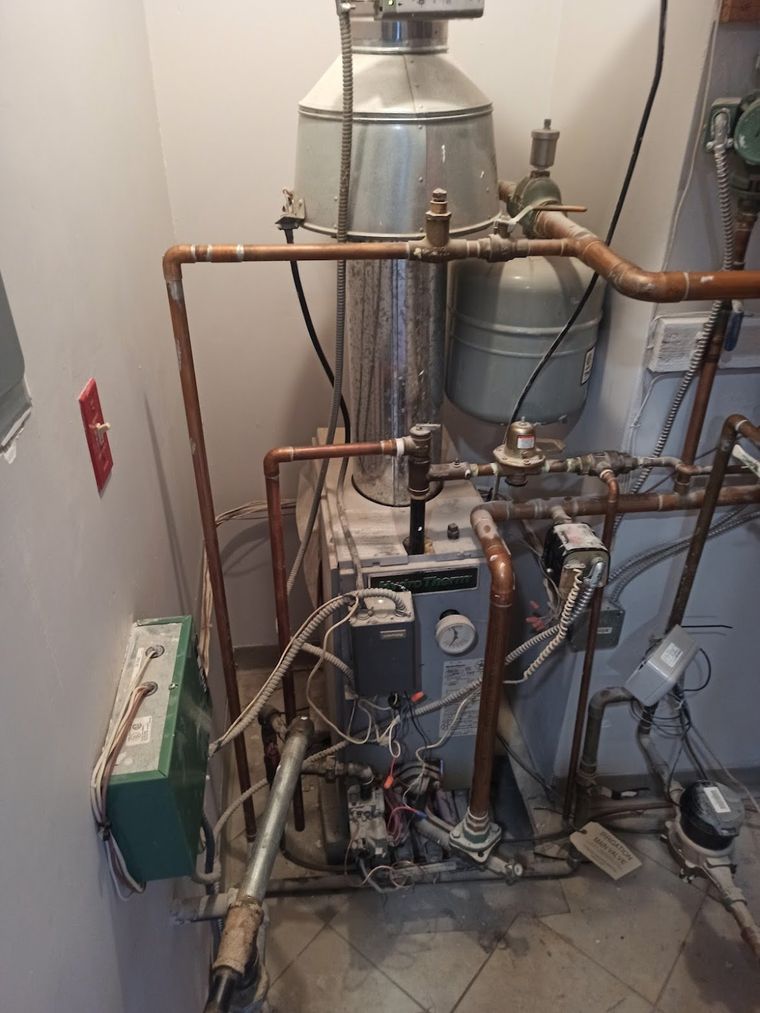
Retiring the old system
A licensed master plumber, or the oil company for an oil system; a tank contractor
If the boiler or furnace goes, it is disconnected or removed; Clean Heat’s decommissioning checklist asks for the plumber’s license, or the oil company’s. The tank is disabled or removed under the Fire Code.
Heat Pump Conversion Costs in Brooklyn
These are the ranges on our NYC price list. In a Brooklyn house three things move the number most: whether there are ducts to use, how much electrical work comes first, and what happens to the old boiler or furnace.
- Ducted heat pump for the whole house
- $7,200–$18,000
- Ducted cold-climate system, new or replacing an old one: heating and cooling in one.
- Room-by-room heat pumps, two to five rooms
- $5,900–$18,000
- Wall, ceiling or slim ducted units on one outdoor unit.
- Heat pump repair
- $250–$900
- Starts with a $200 diagnostic, credited if you go ahead. Compressors and refrigerant leaks are quoted after diagnosis.
- Air-to-water system on your radiators
- Quoted on site
- Depends on the heat load, the radiators and how much hot water the house uses.
What moves the price
- Ducts
- Sound, sealed ducts get reused. Leaky or undersized runs get sealed or resized, and a house without ducts needs another way to move the heat.
- Electrical
- A panel or service upgrade is an electrician’s job with its own price, and on a Clean Heat project Con Edison may require it before work starts.
- The old system
- Keeping the boiler as backup adds integrated controls. Retiring it adds the disconnection, a tank contractor for oil, and a new water heater if the boiler made your hot water.
- Floors and the roof
- More floors usually mean more zones, and a roof stand four stories up, with a lift to get the unit there, costs more than a pad in a side yard.
On incentives: Con Edison’s NYS Clean Heat program pays a fixed amount per single-family house when the heat pump carries the full heating load. That is $7,000 with the old system decommissioned and $10,000 in the Weatherized Tier, or $2,500 with the old system kept behind integrated controls, which can’t use that tier. In disadvantaged communities the three become $8,000 and $11,000 with decommissioning and $4,500 with integrated controls. The Weatherized Tier takes a house built after 2010, past participation in a program such as Con Edison Weather Ready & Sealed or NYSERDA Comfort Home, or a HomeBoost Pro assessment and a Manual J that show a low heat loss per square foot. The incentive comes only as an instant discount on a participating contractor’s invoice; the apartment rates and the rest of the rules are in our NYC heat pump rebate guide.
Every job starts with a written estimate. The full price list covers every service.
Heat Pump and Ducted Jobs, Williamsburg to Marine Park
Whole-house and ducted work our crew has done around Brooklyn, listed north to south. Mini-split jobs are listed on our ductless page.


North
-
Williamsburg
- Condensate leak stopped on a Mitsubishi Electric air handler with an added drain pan
-
Park Slope
- New 3-ton air handler on an existing ducted system, outdoor unit and lines kept
-
Midwood
- Heat pump water heater installed in place of an old water heater
-
Midwood / Flatlands
- Water-source heat pumps on a seasonal maintenance plan
-
Gravesend
- Tosot heat pump, 5 tons, paired with a new gas furnace; outdoor unit on wall brackets
-
Marine Park / Mill Basin
- Two Cooper & Hunter heat pumps, 5 tons each, with new air handlers, plenum, ductwork and smart thermostats
- Cooper & Hunter heating and cooling system, 36,000 BTU, replaced
South
Heating and Cooling Jobs, in the Owners’ Words
All reviews on GoogleArt saved the day! I called on a very cold Sunday. They managed to get out here and replaced a worn-out part on my upstairs HVAC heater (had part on-hand) to get the heat back on. They had to order a part for the downstairs, but came with it next-day. Fast, courteous and prompt. Highly recommended!
An HVAC company I've used for several years told me I needed a new furnace at a huge price tag, so I decided to get a few other estimates. Stan came to look at it and was doubtful about the urgency of replacing it (it works fine). I also asked him to look at my hot water heater which was at the end of its useful life. His estimates were way lower than my old provider. At the same time, another residence in my building had a hot water heater failure, so I decided to replace mine now. Stan explained the differences in types of heaters to me in clear terms, and helped me make an informed decision. The company is responsive, flexible, reasonably priced, and patient with my odd setup. Five stars.
We needed to replace our old HVAC unit, but unfortunately, we had issues with a previous company that started the job and then disappeared. Thankfully, Artem and Stan from Art HVAC came to the rescue and did an amazing job! From start to finish, the process was smooth and stress-free. Their team was professional, efficient, and super knowledgeable. They handled everything seamlessly, and now our new unit works perfectly. The pricing was fair, the quality of work was excellent, and the customer service was top-notch. I highly recommend Art HVAC to anyone looking for reliable and high-quality service! Thank you for the great work!
Calling for repair my house heater. Very quickly and professionally technician service. Highly recommended
What Brooklyn Owners Ask Before Switching to a Heat Pump
Can a heat pump run my steam radiators?
No. Steam needs water boiled past 212°F, and even a high-temperature air-to-water heat pump makes water up to about 158°F. In a steam house the heat pump heats the air instead, through wall units, slim ducted units or ducts on the top floor. The boiler can stay as backup or be retired once the heat pumps carry the whole load.
Can I keep my boiler or furnace as a backup?
Yes. With integrated controls the heat pump runs first and the old system covers the coldest hours. Con Edison’s Clean Heat program pays $2,500 for that setup in a single-family house, against $7,000 when the old system is decommissioned, and the Weatherized Tier does not apply to it. A heat pump paired with a new furnace does not qualify at all.
Will a heat pump keep the house warm in a cold snap?
If it is sized for the house, yes. Clean Heat sizes homes here to 17.3°F, and the system has to carry 100% of the heating load at that temperature; electric heat strips no longer count toward it. Cold-climate models keep heating well below that, at a lower efficiency: ENERGY STAR’s cold-climate minimum is a COP of 1.75 at 5°F.
Is my electrical service big enough for a heat pump?
In an older house, maybe not. NYSERDA’s guide for installers says homes with less than 100-amp service, or built before 1965, likely need more amperage. We check the panel on the first visit. On a Clean Heat project Con Edison must confirm the service before installation, and any upgrade it requires is done first by an electrician.
What happens to my oil tank?
In NYC a tank taken out of use after a switch to a heat pump has to be disabled in place or removed under the Fire Code, and the Clean Heat program recommends removing it. An oil-tank contractor does that work, and the Department of Buildings answers questions about it.
My boiler makes my hot water. What replaces it?
A heat pump water heater, an air-to-water heat pump with its own tank, or a standard water heater. A heat pump water heater needs a space that stays between about 40°F and 90°F, according to ENERGY STAR, with air around it. Con Edison’s discount on qualifying models comes off the price at the store or distributor.
Should I replace the whole heat pump or just the outdoor unit?
It depends on the refrigerant and the age. An existing R-410A system can keep running and be serviced, but New York counts a system as new once enough major parts are replaced, and new systems here have used lower-GWP refrigerants since January 1, 2026. On an older R-410A system with a failed compressor, replacing the whole system is often the cleaner job. We check what applies before quoting.
Do you install heat pumps in Manhattan Beach and nearby?
Yes. Our office is on Stuart Street in south Brooklyn, and in Manhattan Beach, Marine Park, Mill Basin and Gravesend we often work on houses with a furnace and ducts, where a ducted heat pump is the simplest swap. In a mapped flood zone the outdoor unit goes up on a platform or a bracket.
More on Heat Pumps, Prices and the Borough
- Service Heat pump installation Ducted and ductless heat pumps across NYC
- Area Mini-splits in Brooklyn Outdoor unit spots, landmarks and flood zones
- Area Heating and cooling repair When the system you have stops working
- Prices Price list Every service with its price range
- Guide NYC heat pump rebates Clean Heat categories, amounts and conditions
- Guide Lowering your heating bill Gas, oil and heat pump costs side by side
- Guide Heat pumps in NYC winters Defrost, design temperature and backup heat
- Brand Daikin heat pumps FIT and FIT AURORA for houses with ducts
- Service Duct inspection Leak testing before old ducts are reused
- Area Tune-ups by system Yearly checks for heat pumps, boilers and furnaces
- Area All services in Brooklyn Everything else we do for homes and businesses here
Planning to Retire an Oil or Gas Boiler?
Tell us what heats your Brooklyn house now, how many floors it has and whether the boiler also makes your hot water. We’ll measure the house, check the panel and give you a written estimate for each option that works.